


Future
Coordination
未来云坐标
“Architecture is not merely a physical shelter; it can also reconstruct the relationship between people and place.”
——Peidong Zhu
Project Name: Future Cloud Coordinate
Design Firm: line+ studio
Principal Architect / Project Lead: Peidong Zhu
Design Team: Xin Feng, Yang Zhou, Mengying Du, Zixuan Wang(intern), YuYing Chen(intern)
Client: People’s Government of Yuhang District, Hangzhou
Design Development, Fabrication & Installation: Anhui Beiduo Inflatable Products Co., Ltd.
Location: Gexiang Lianhuachi, Yuhang District, Hangzhou
Area: 225 m²
Design Period: August–September 2025
Construction Period: October 2025
Structure: Carbon-fiber composite and inflatable air-bladder system
Materials: SPH polyurethane composite (outer surface), TPU polyamide fiber composite (inner bladder), T700 carbon-fiber composite (structural frame), 304 stainless steel (hardware)
Photography: Chen Xi Studio, line+
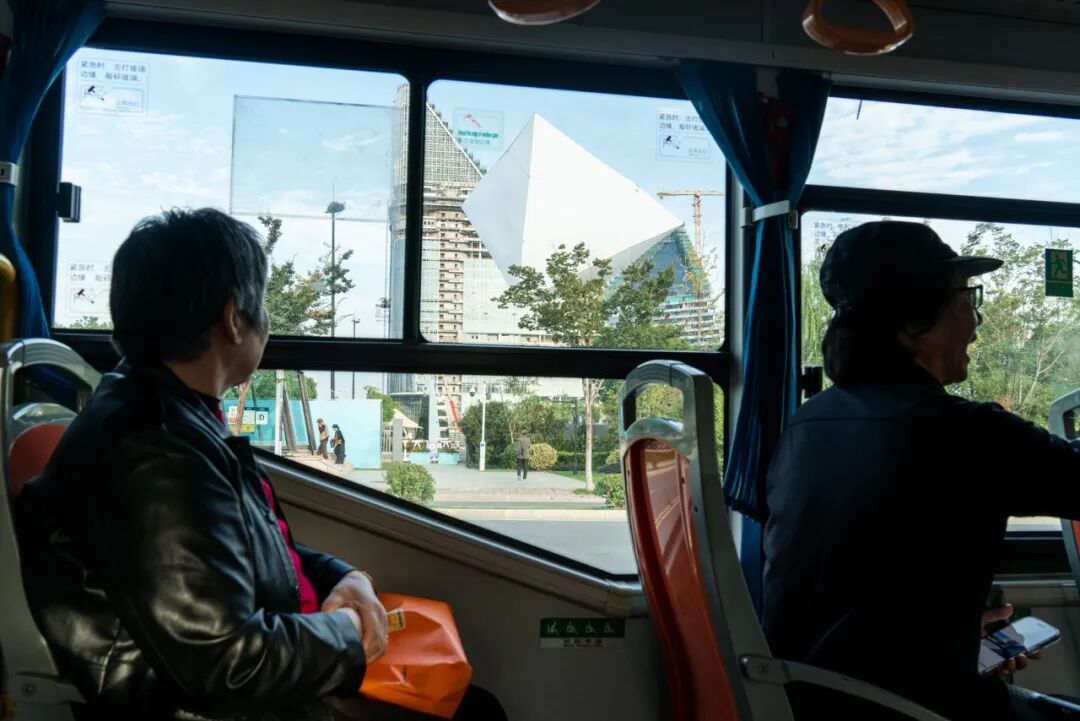
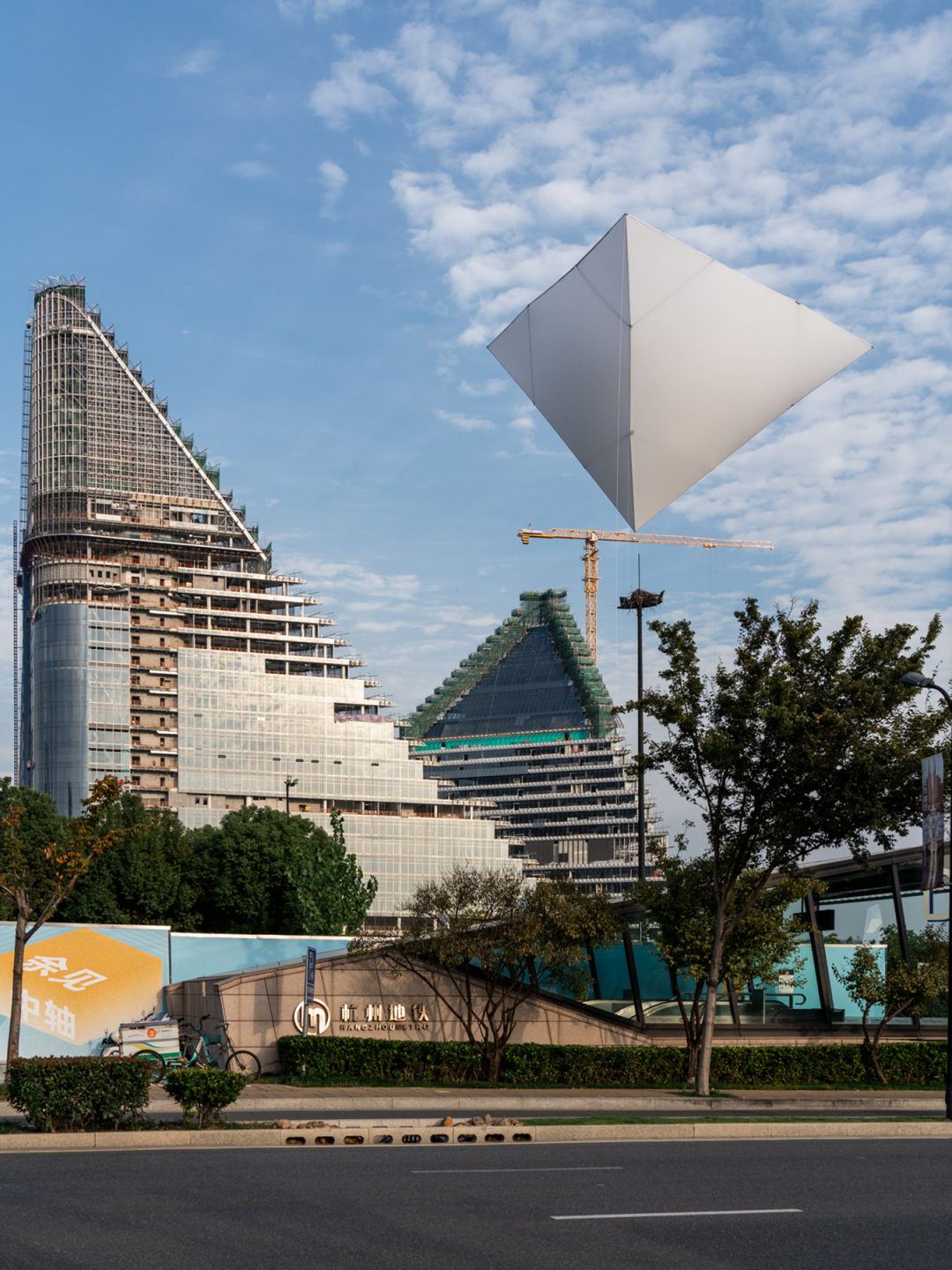
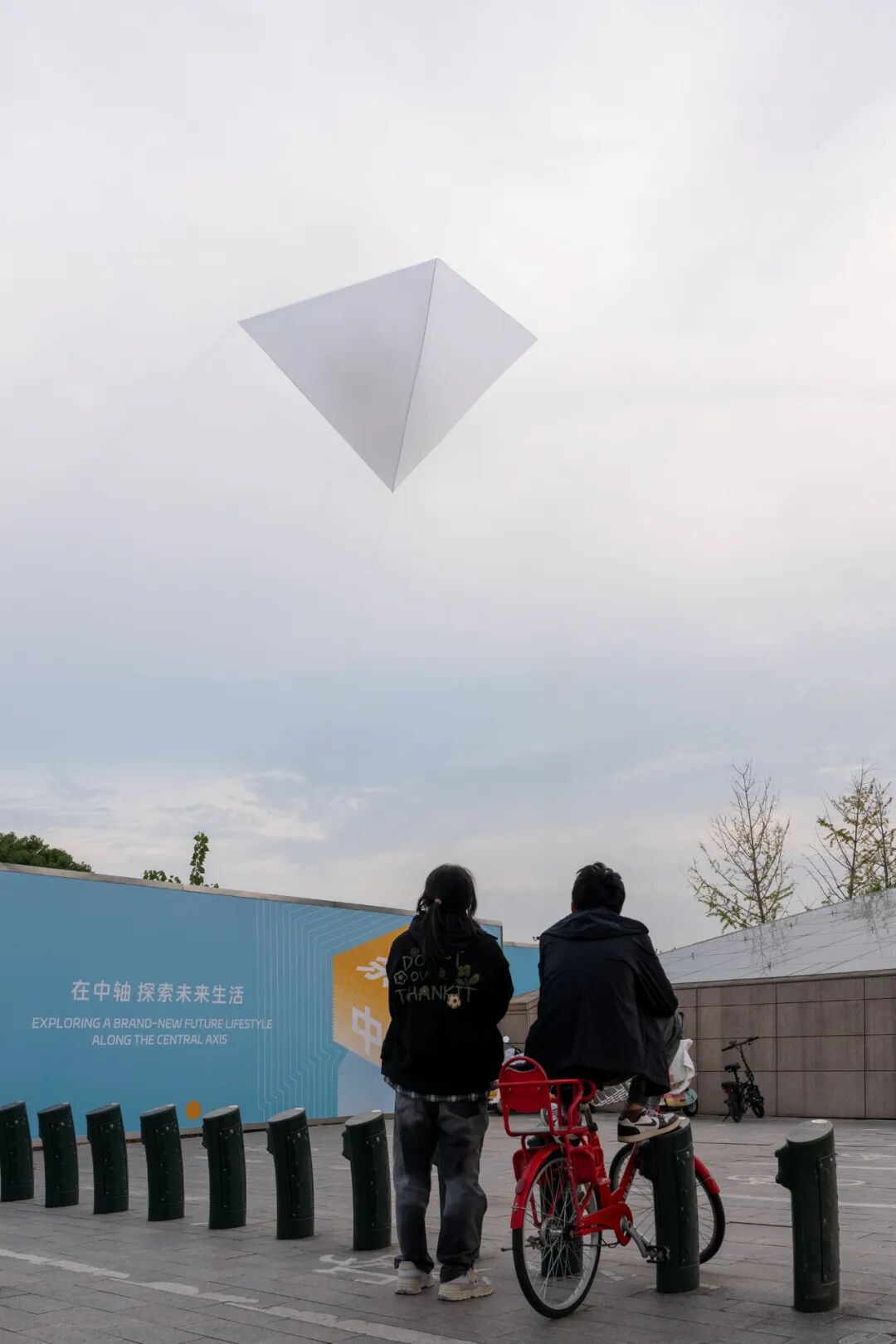
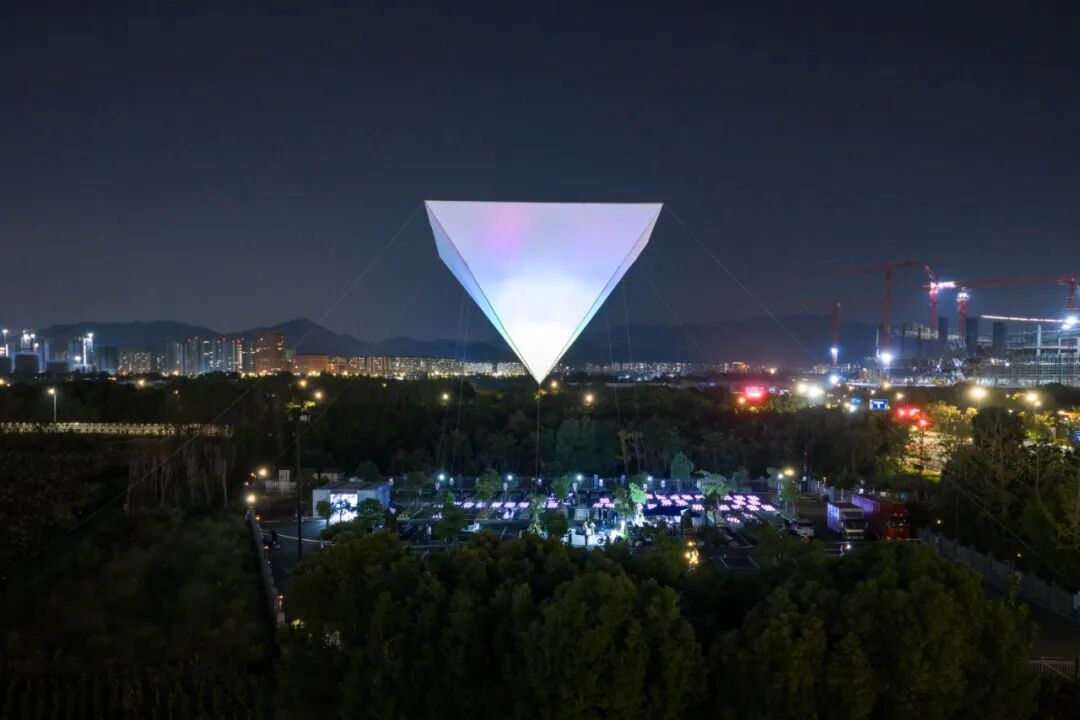
Designed by Peidong Zhu, co-founder and principal architect of line+ studio, the large-scale suspended art installation “Future Cloud Coordinate” has officially lifted off along the Yuhang Central Axis, a key emerging urban center in Hangzhou, becoming a striking new urban signal.
As a core node of the Central Axis Future Exploration Day and Urban Micro Aesthetics of the Central Axis, “Future Cloud Coordinate” functions not only as a visual landmark but also as a public invitation oriented toward the future. The installation aims to stimulate collective imagination and invite the public to co-envision future urban scenarios.The exhibition is organized by Róng Design Library, curated by Zhang Lei and Lu Jingyi, and brings together eight groups of artists and designers. Set against the backdrop of Yuhang’s Central Axis, the exhibition explores how art and design can intervene in public space and contribute to the evolution of urban macro-aesthetics.
Beginning with the earlier installation Sky Ring, line+ has continuously explored cross-disciplinary practices to redefine the relationship between people and place. While the Sky Ring was situated within a natural landscape to recalibrate human perception of environmental rhythms, Future Cloud Coordinate shifts toward the urban core, engaging a far more complex public context and further probing the boundaries between architectural materiality, technology, and public space.
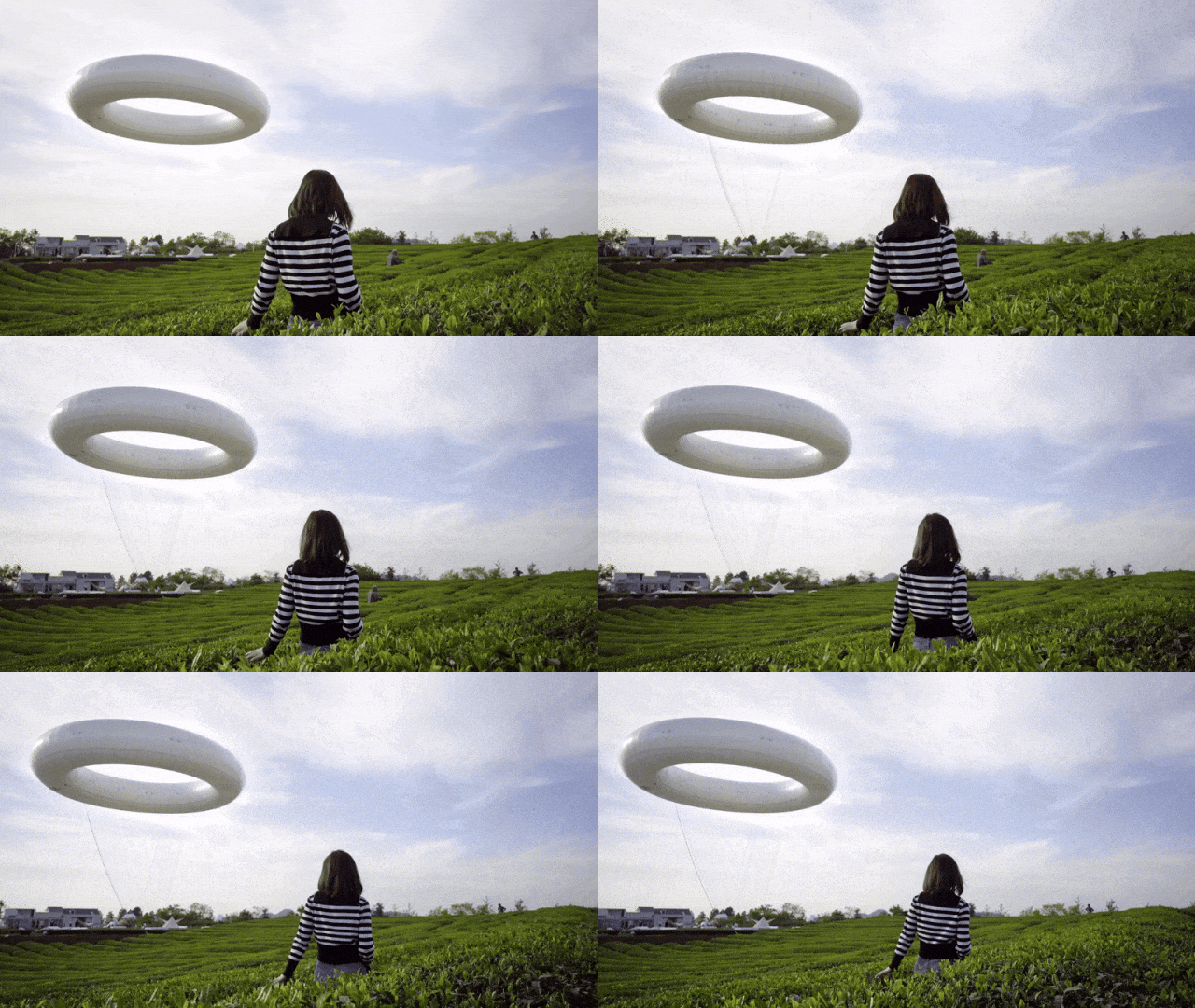
△ Sky Ring
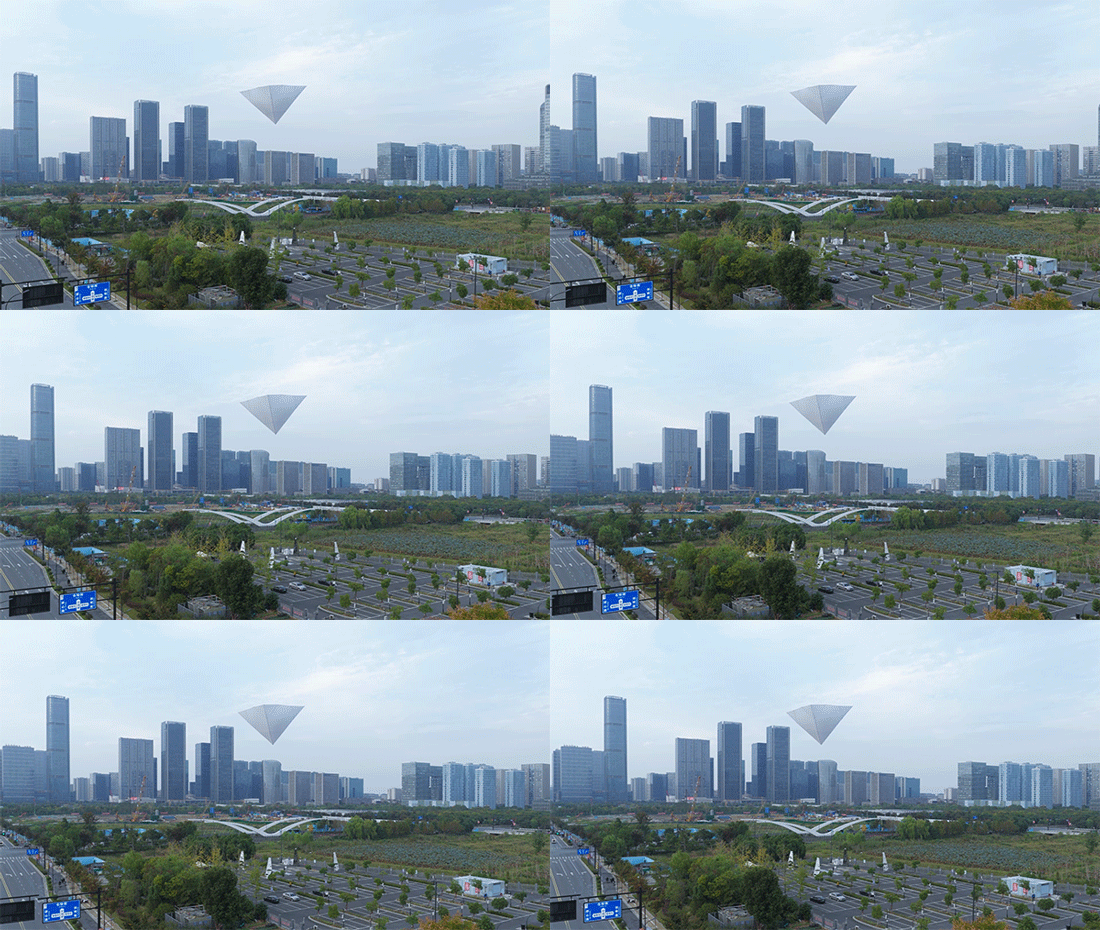
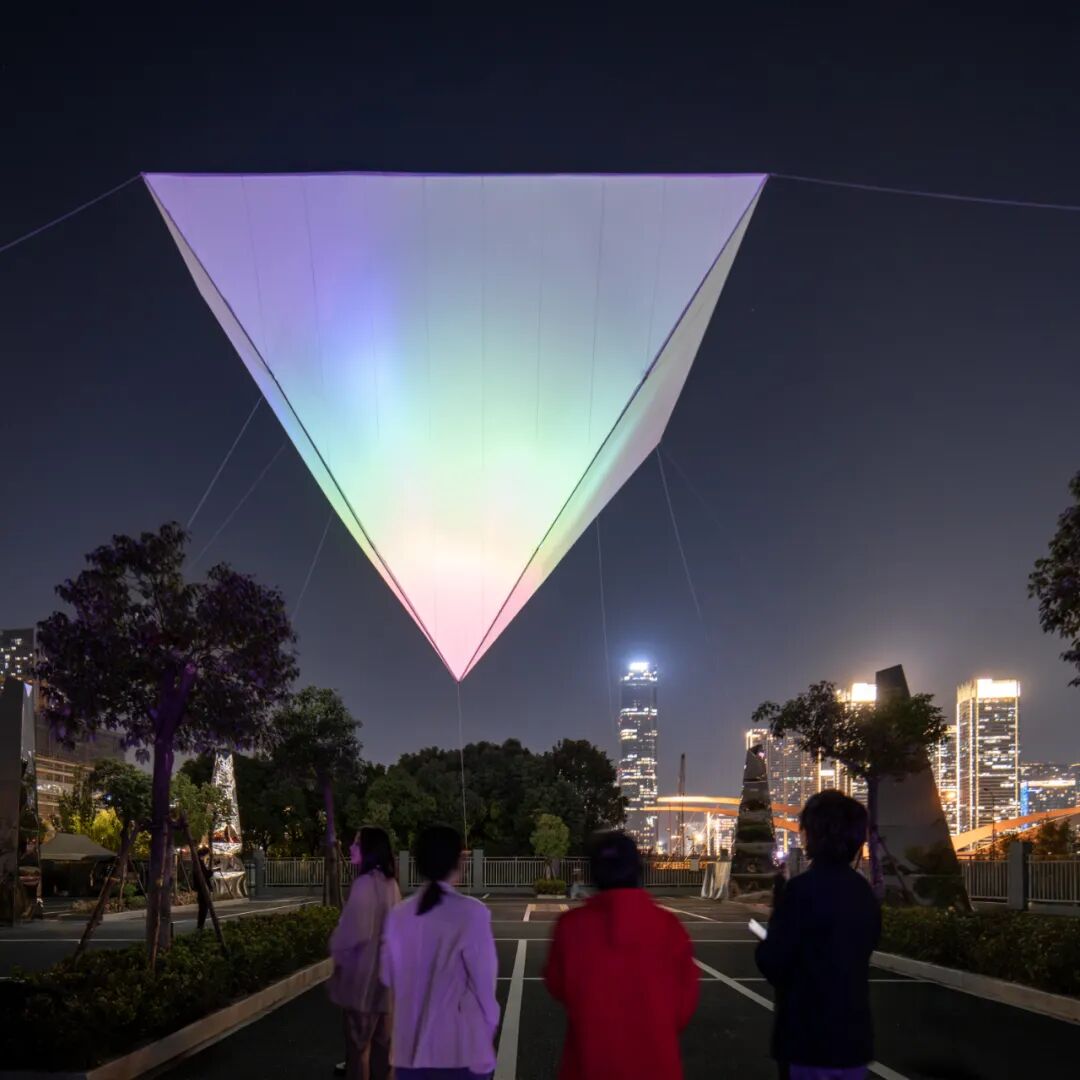
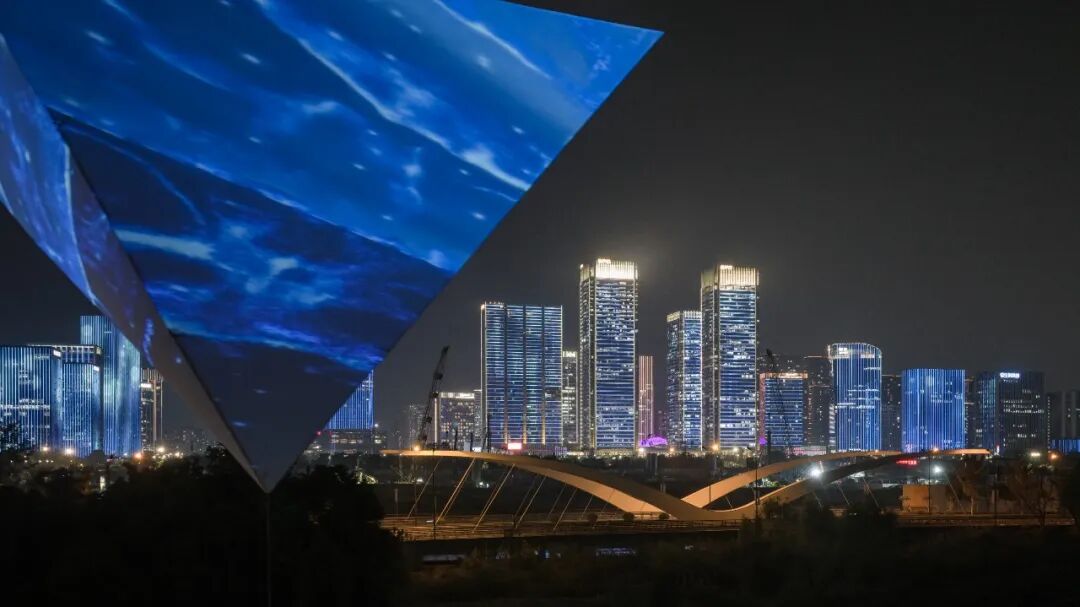
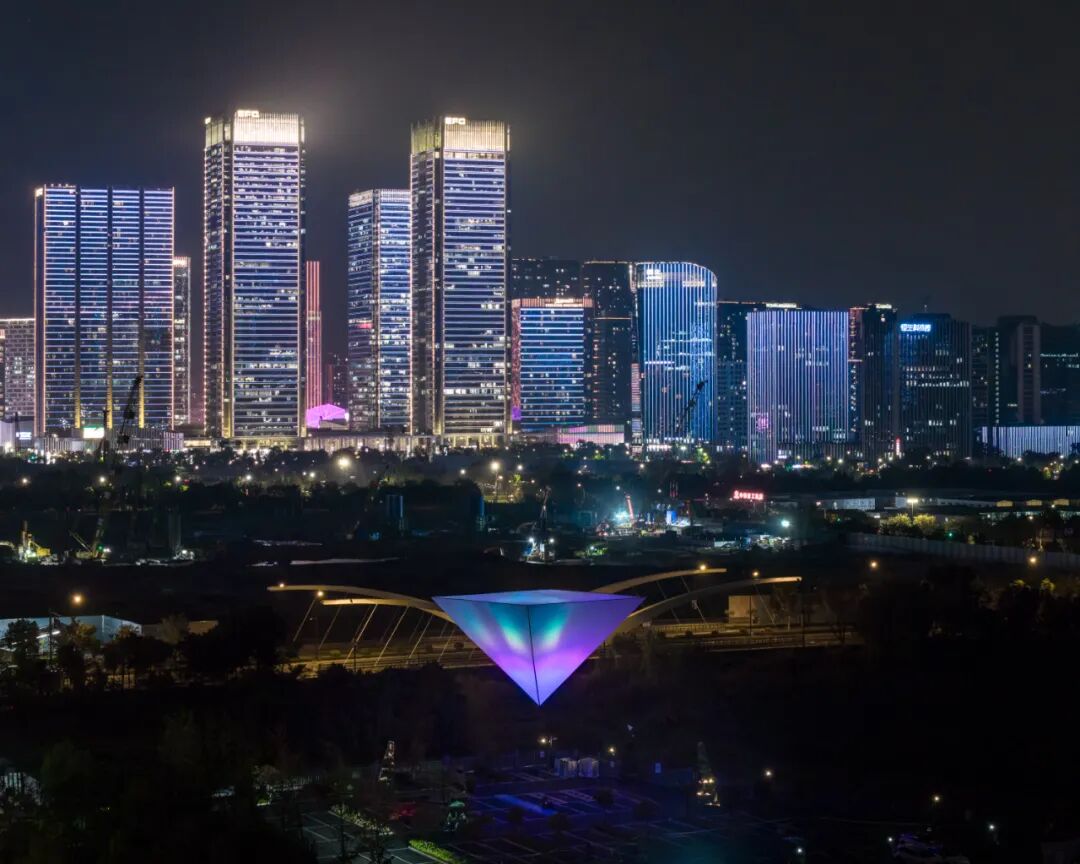
△ Future Cloud Coordinate
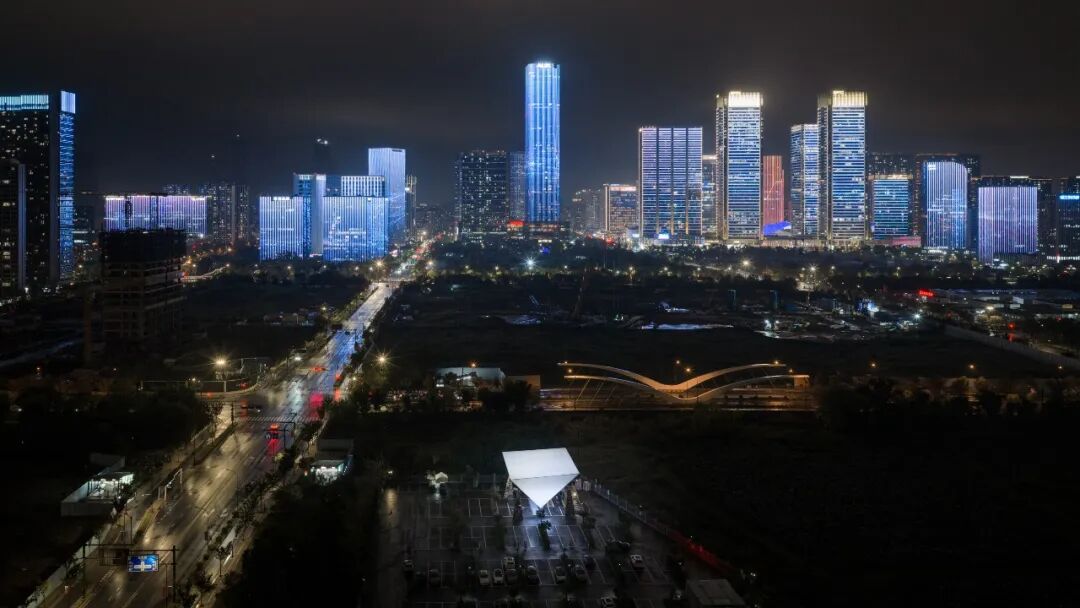
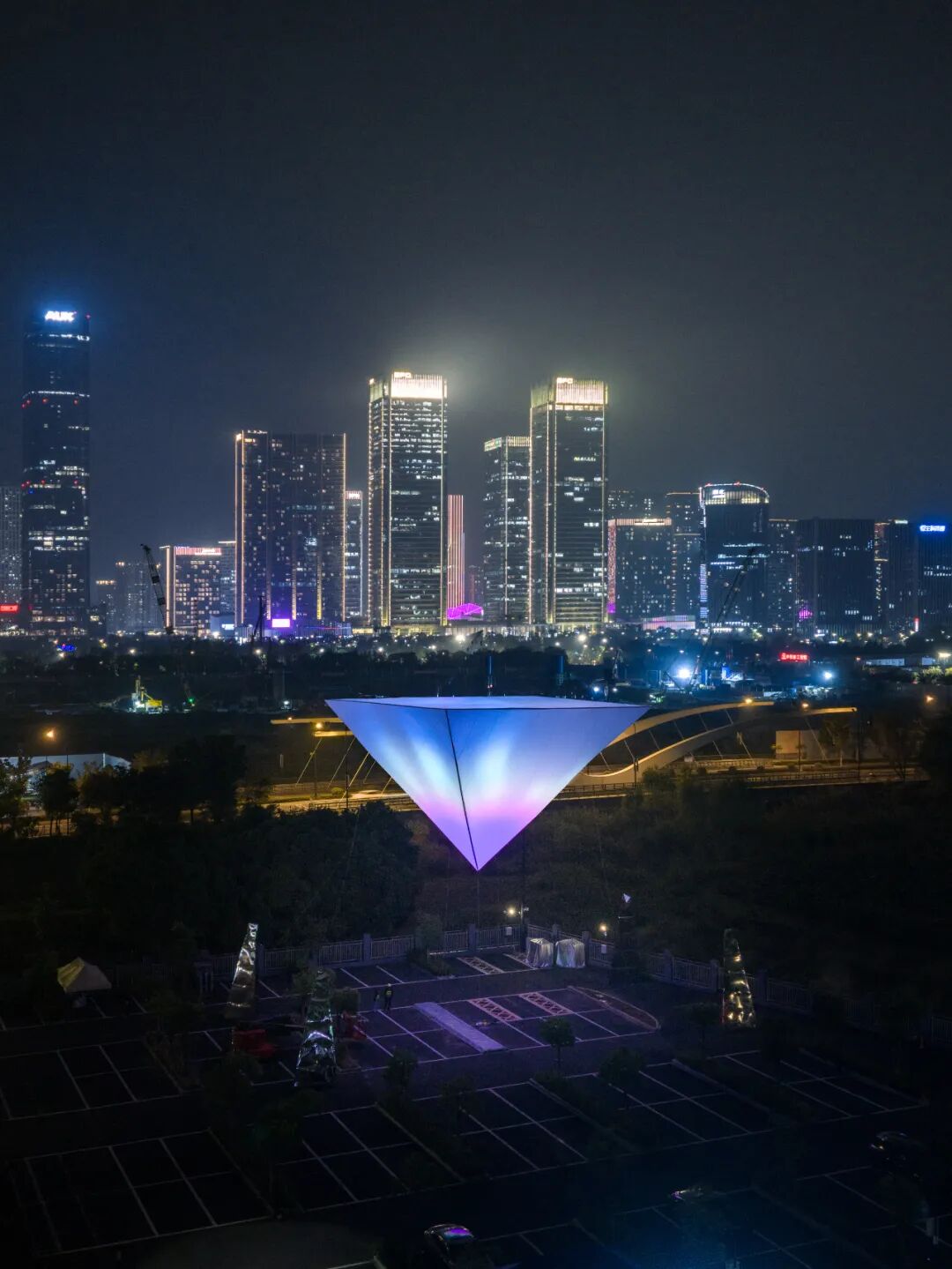
Yuhang, home to major technology enterprises such as Alibaba, ByteDance, and Vivo, is rapidly emerging as a new urban center of Hangzhou. The installation is located at the most critical landmark node along the Yuhang Central Axis, adjacent to the site of the 350-meter twin towers. Positioned between the retained lotus pond with its original ecological texture and the rapidly rising high-rise cluster, the installation introduces a pronounced sense of heterogeneity, reconstructing the site’s temporal and spatial relationships.
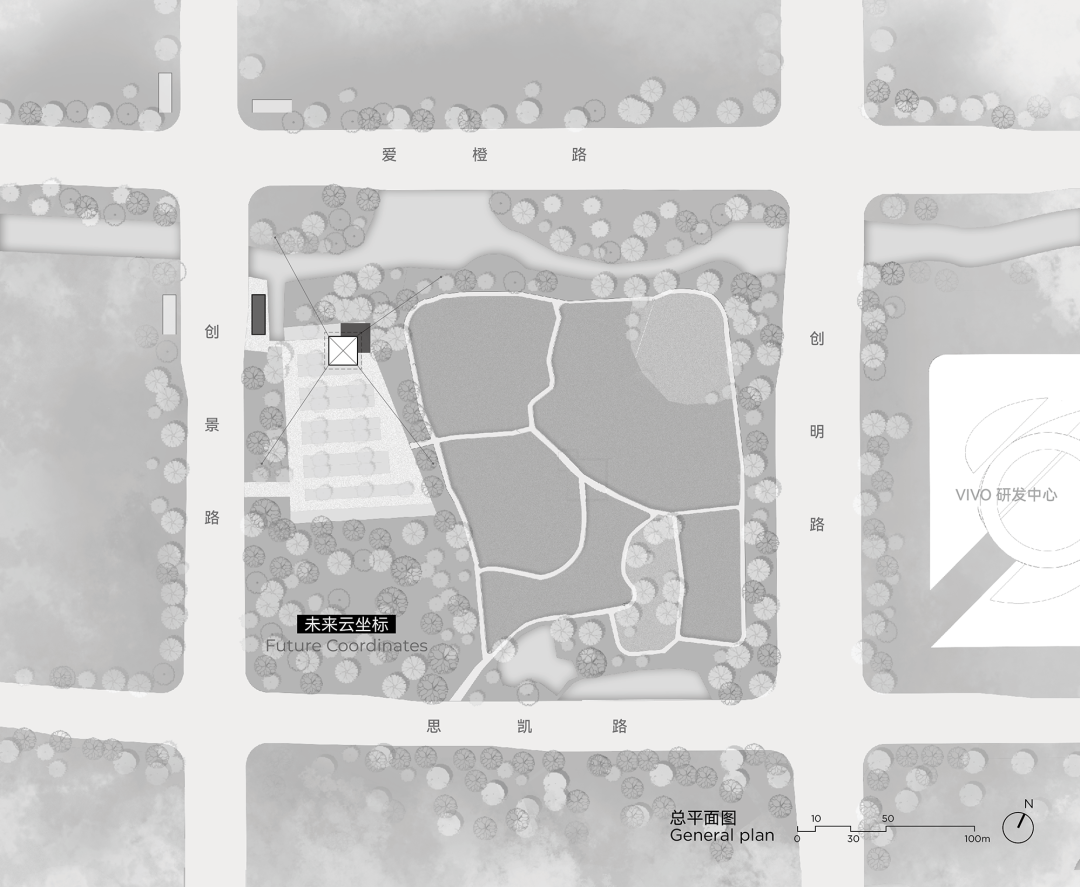
△ Master Plan
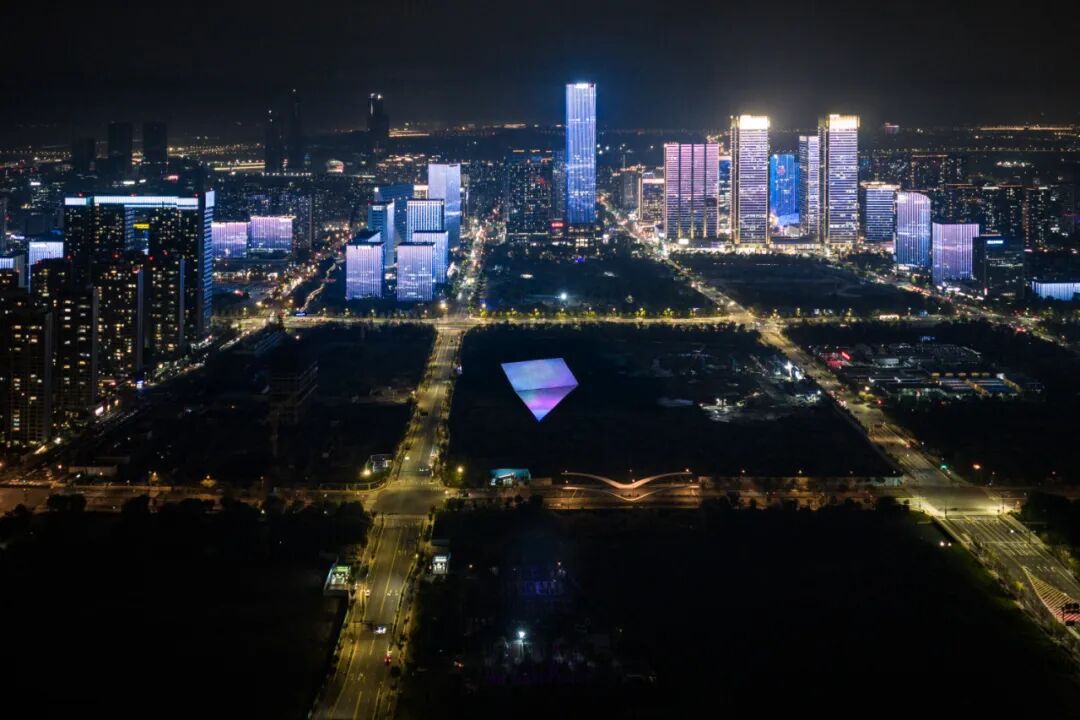
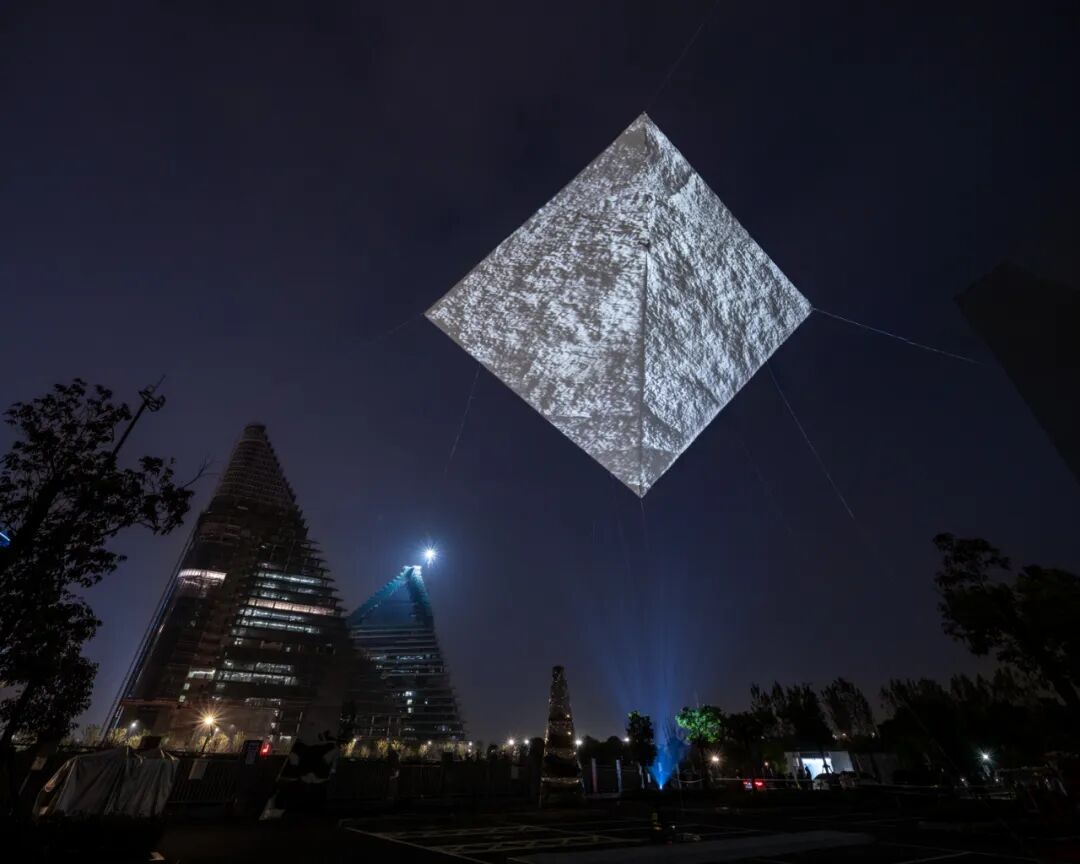
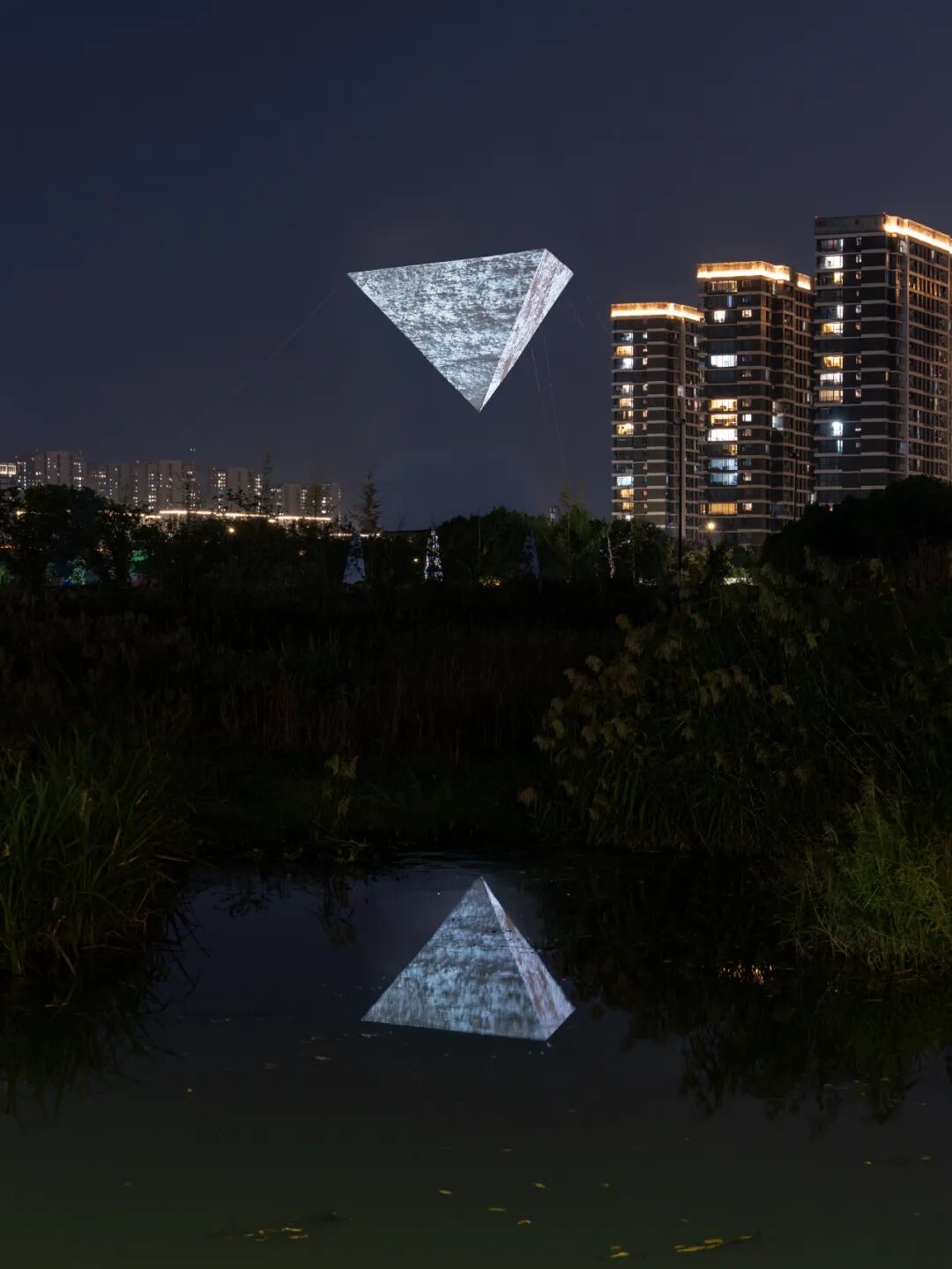
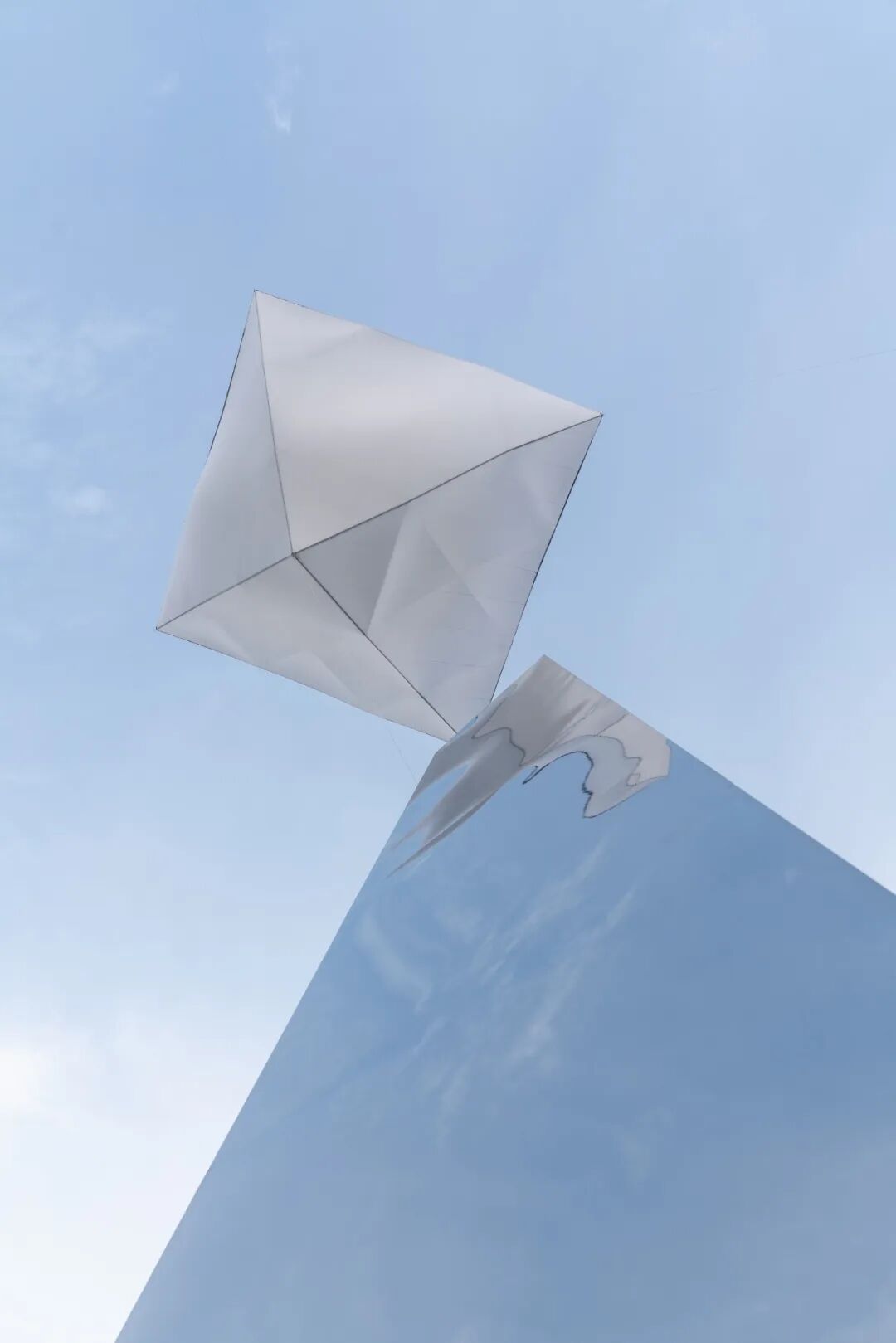
Future Cloud Coordinate continuously responds to spatial order and visual perception through state transformation. In its ground-based state, the Tower of Light operates as a static landmark anchoring the urban fabric. Once airborne, it transforms into the Cloud Coordinate, a dynamic reference point that activates urban imagination. This transformation reveals architecture’s potential as a medium—no longer a fixed shelter, but a dynamic agent capable of reshaping public perception of time, space, and collective relationships.
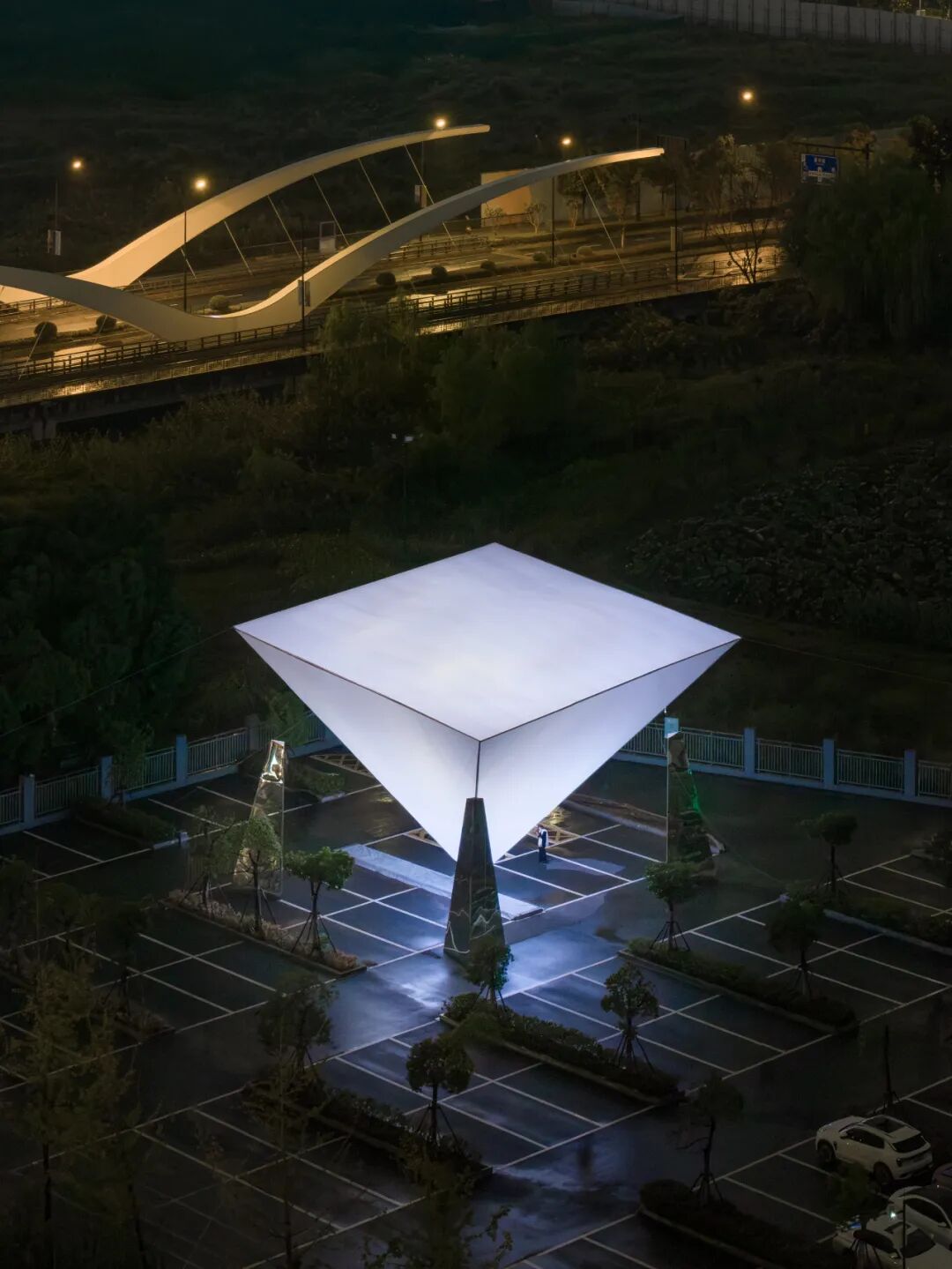
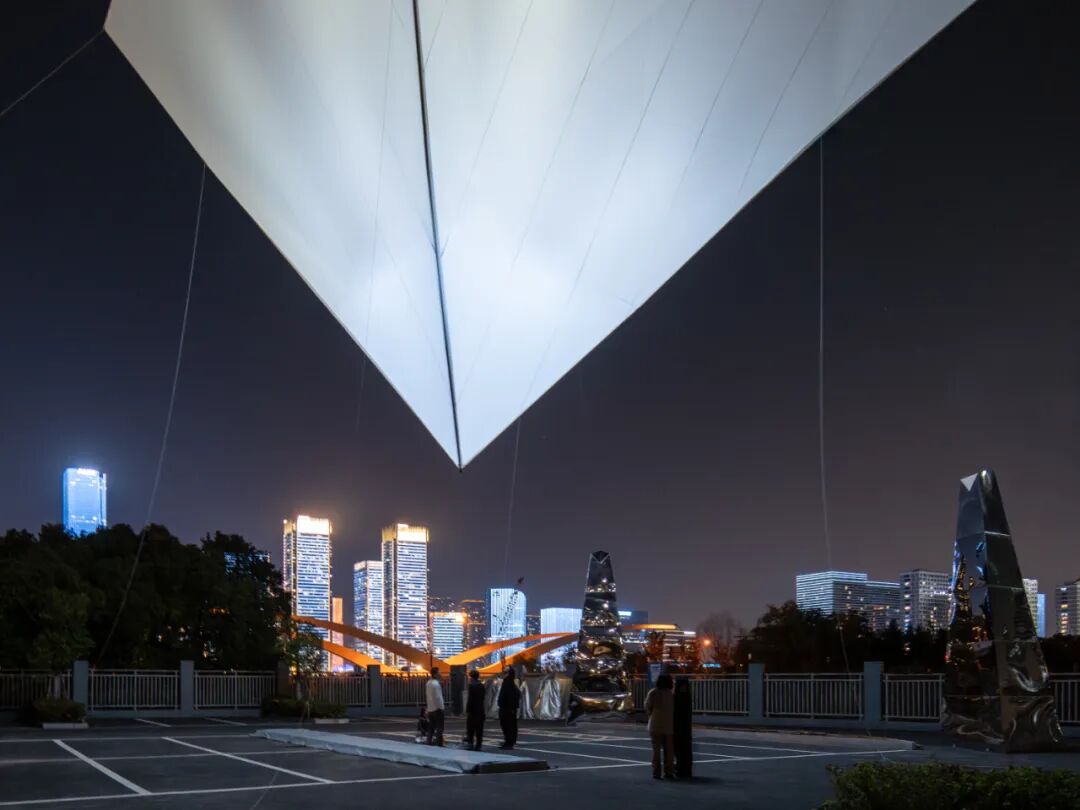
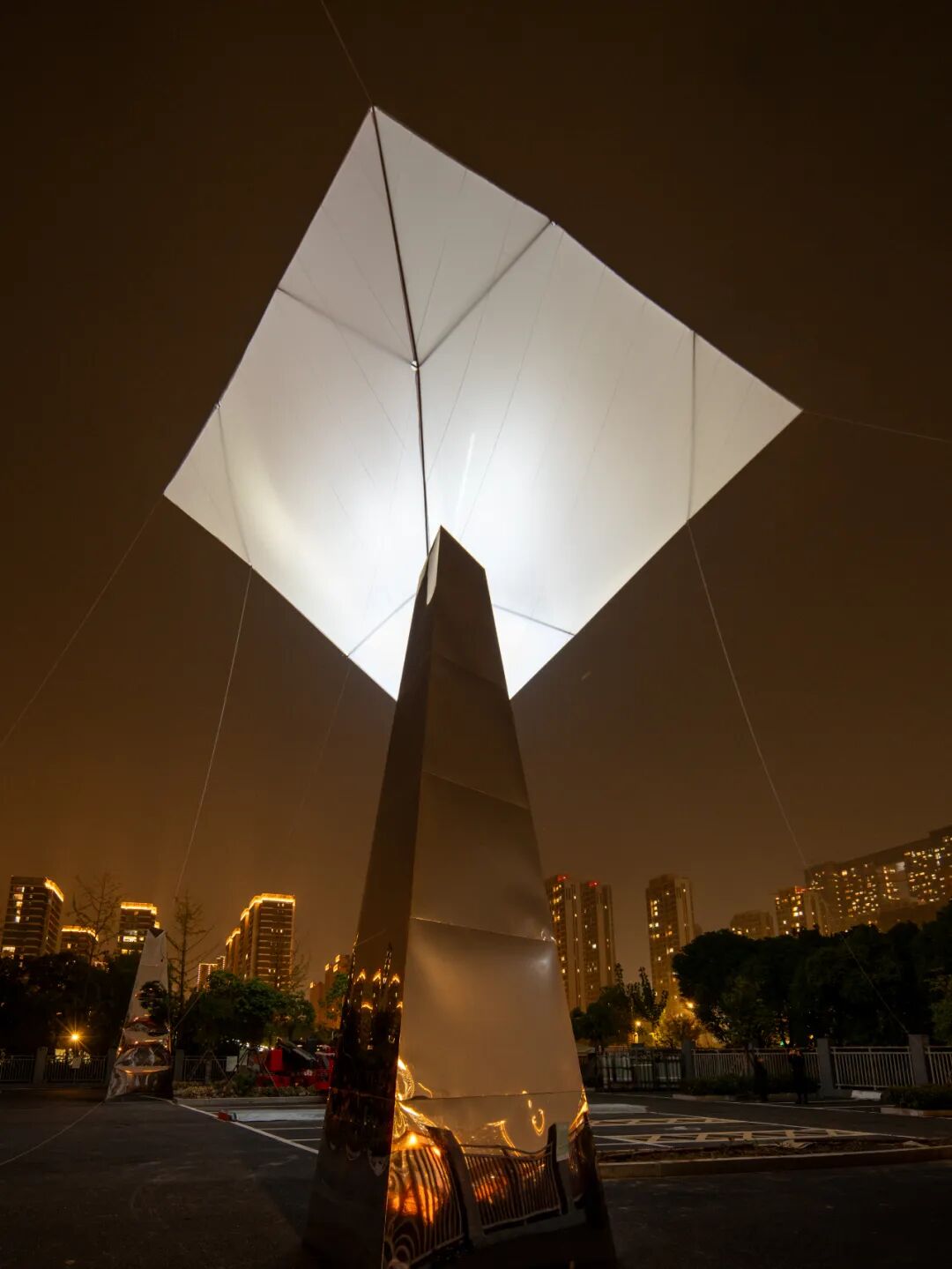
△“Tower of Light” in Grounded State
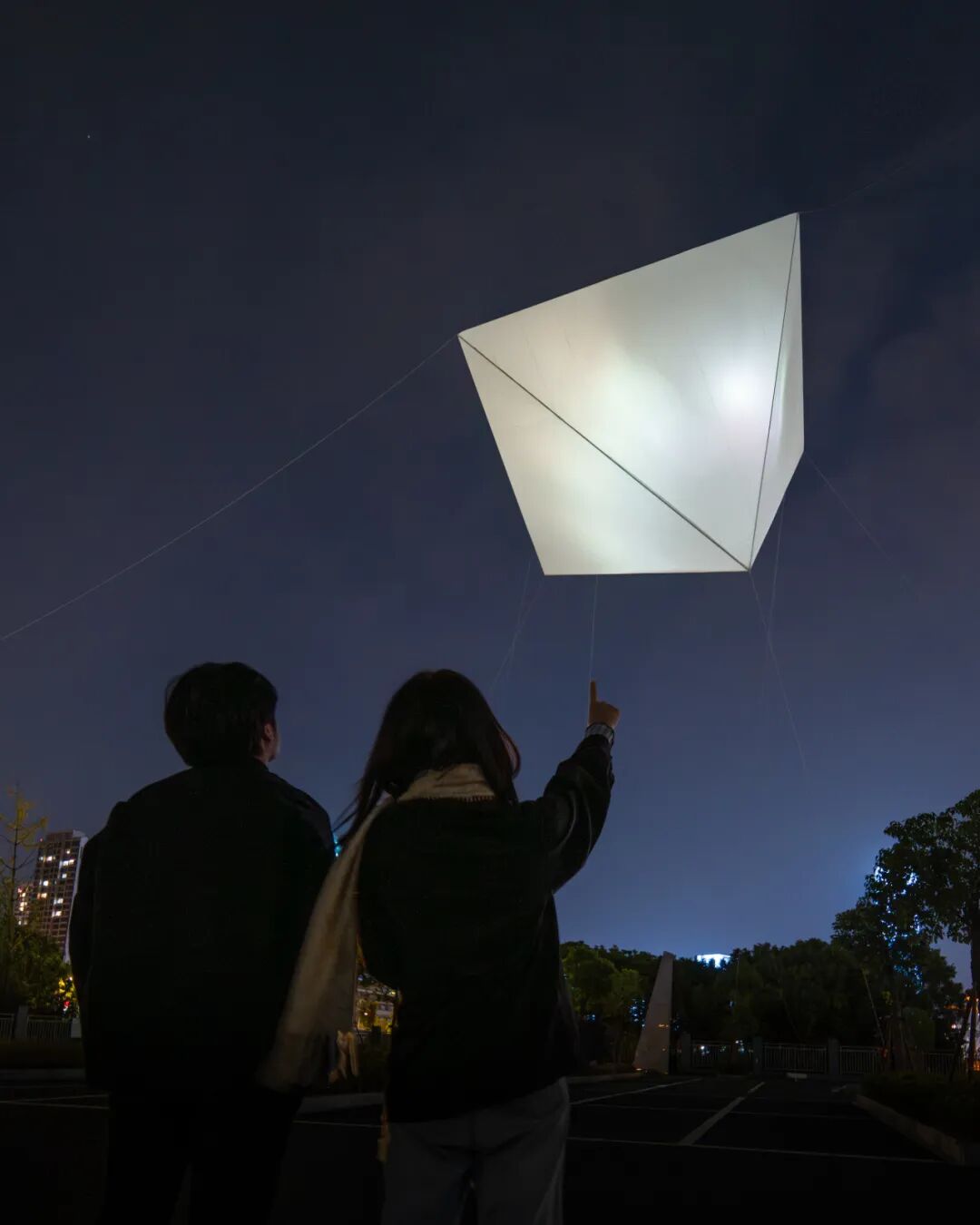
△“Cloud Coordinate” in Airborne State
Through the acts of inversion and ascent, the installation subverts architecture’s conventional reliance on mass and stability to resist gravity. Instead, “resistance to gravity” is rendered as an immediate, perceptible visual experience. Ongoing urban change is thus translated into a participatory public event—one that can be perceived, experienced, and collectively interpreted.
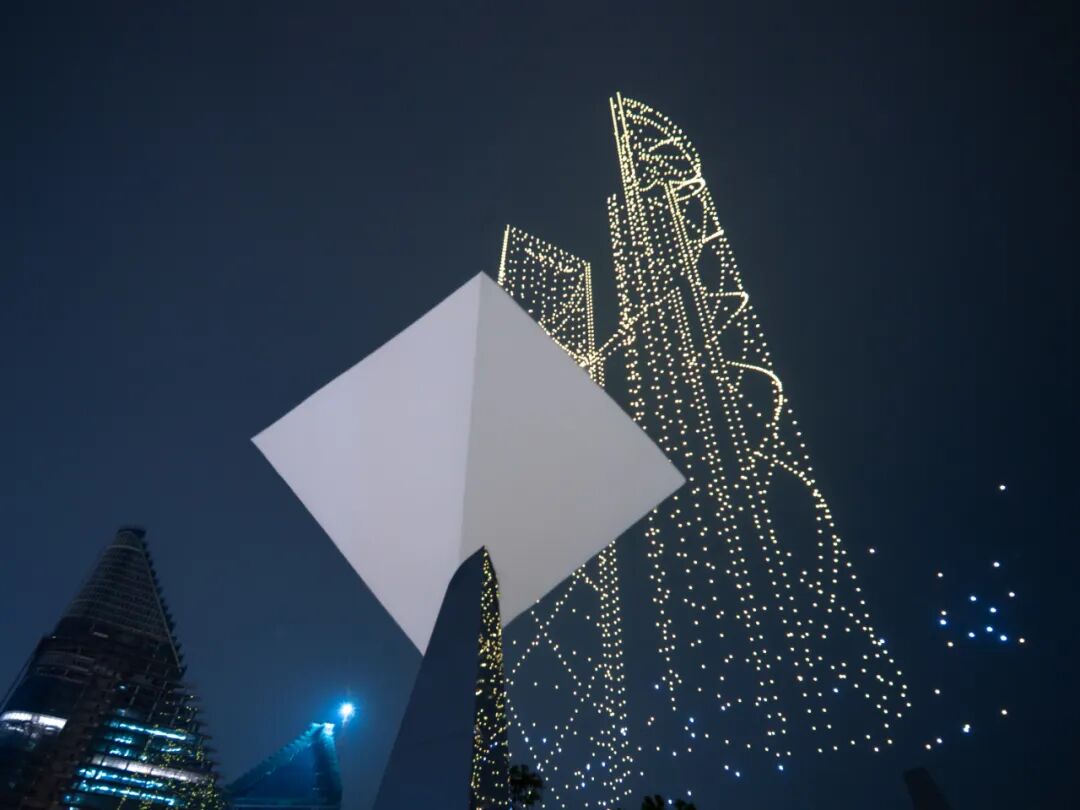
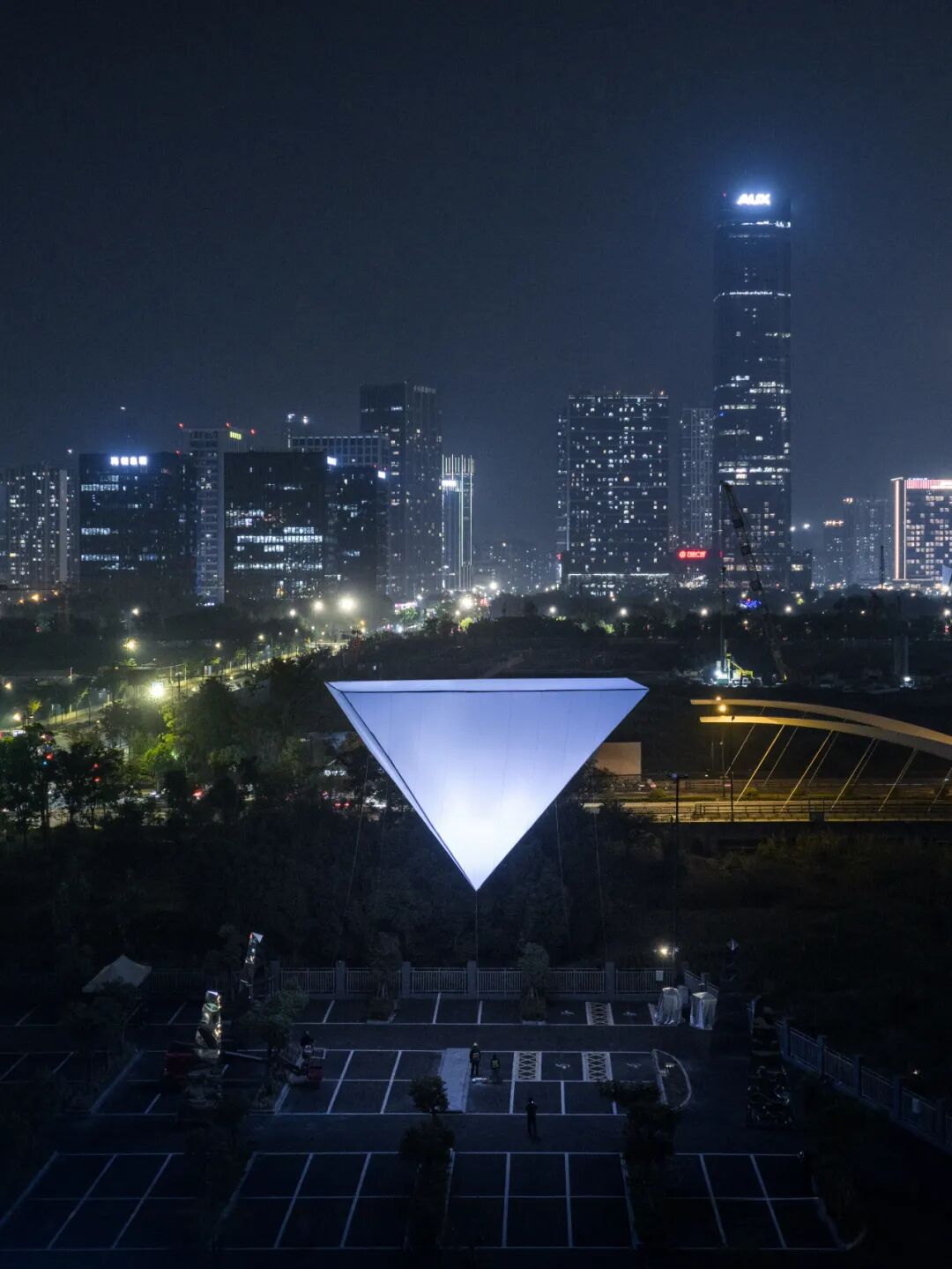
| Tower of Light: An Inverted Landmark
The installation derives its geometric prototype from the triangular motif of the Future Sci-Tech City logo, evolving it into an inverted square pyramid with a side length of 15 meters. In contrast to the pursuit of permanence and stability associated with upright forms, the Tower of Light presents an extreme threshold condition through its visually paradoxical “top-supported, bottom-suspended” configuration.
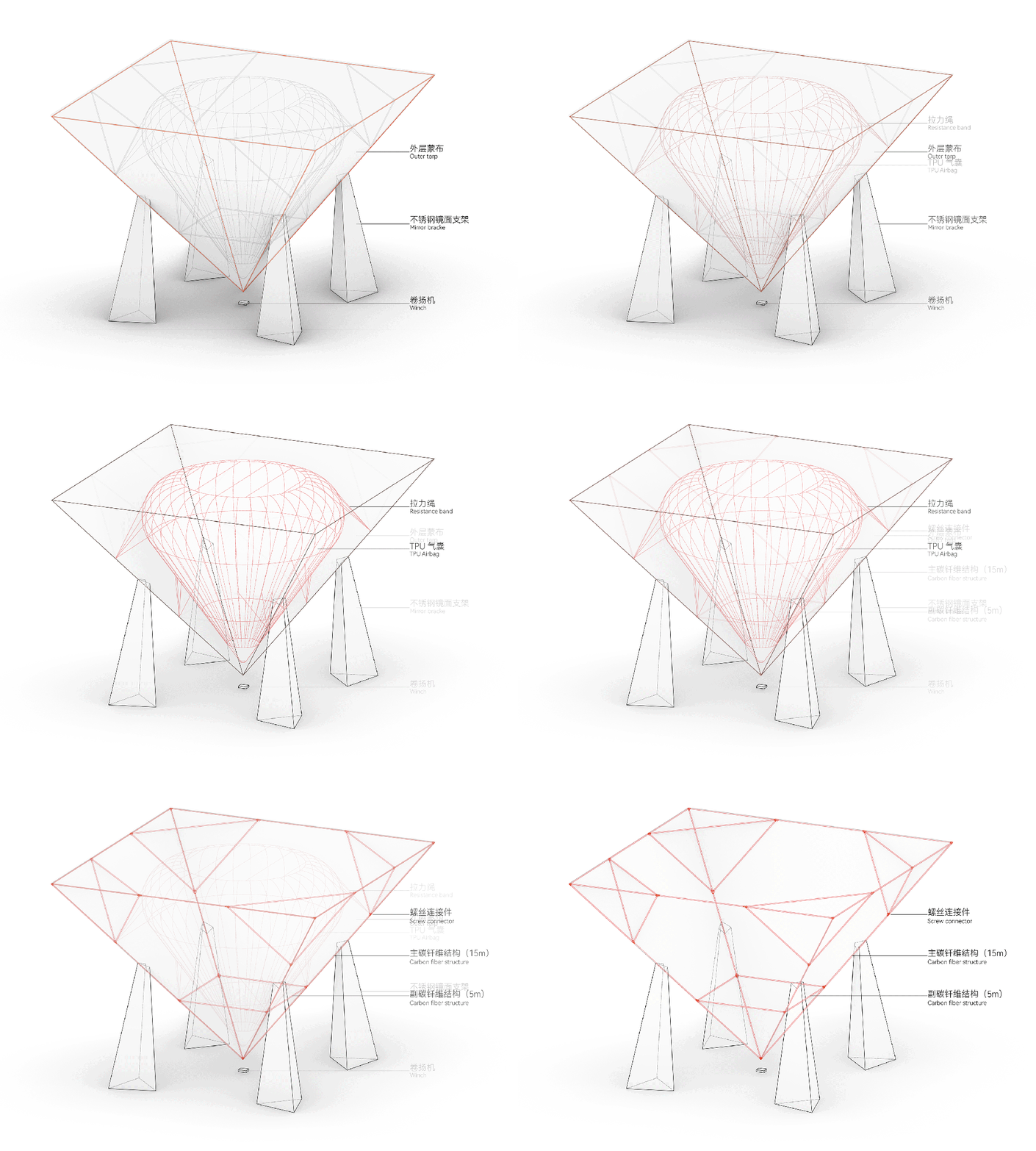
△ Axonometric Structural Analysis
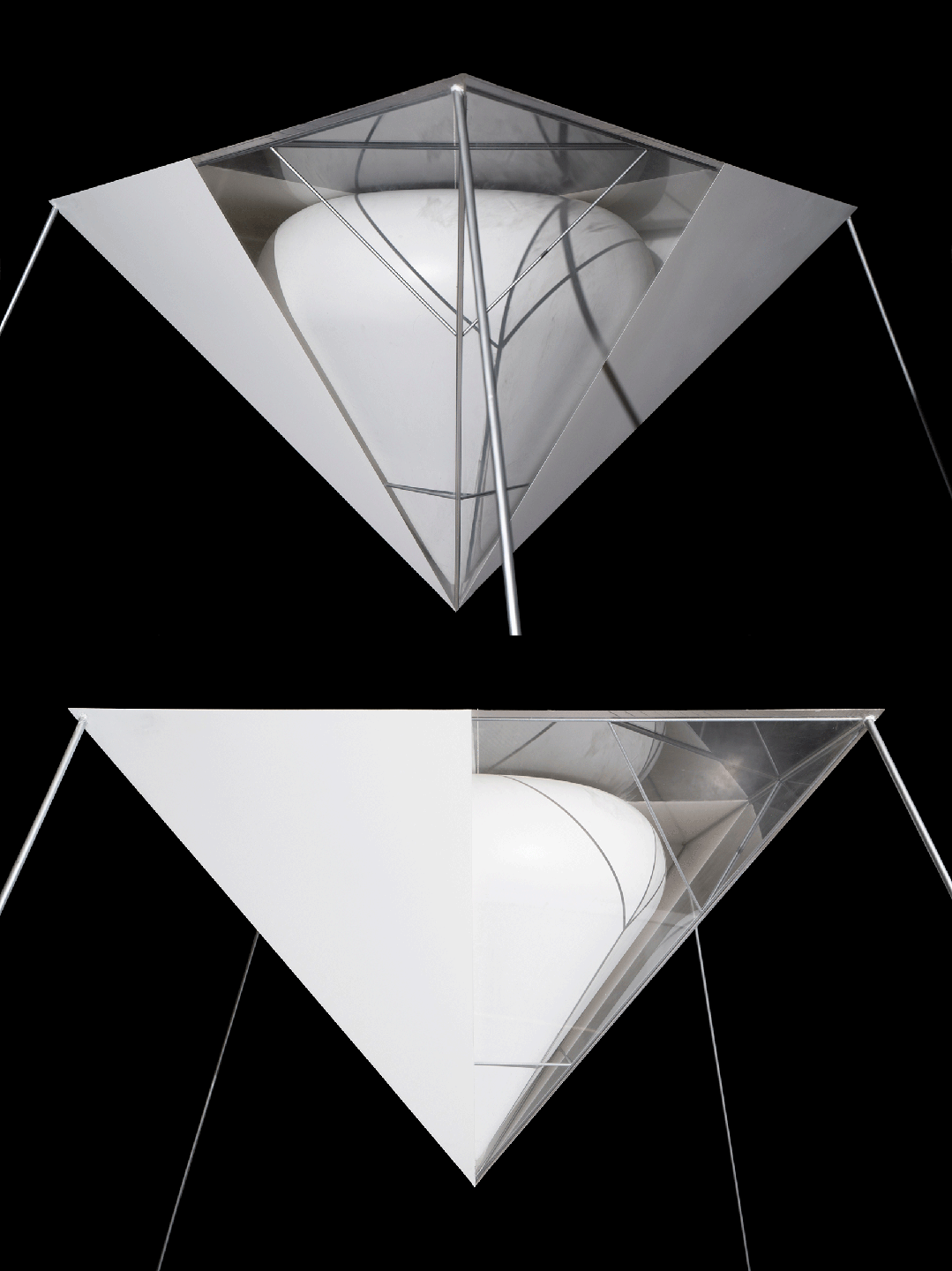
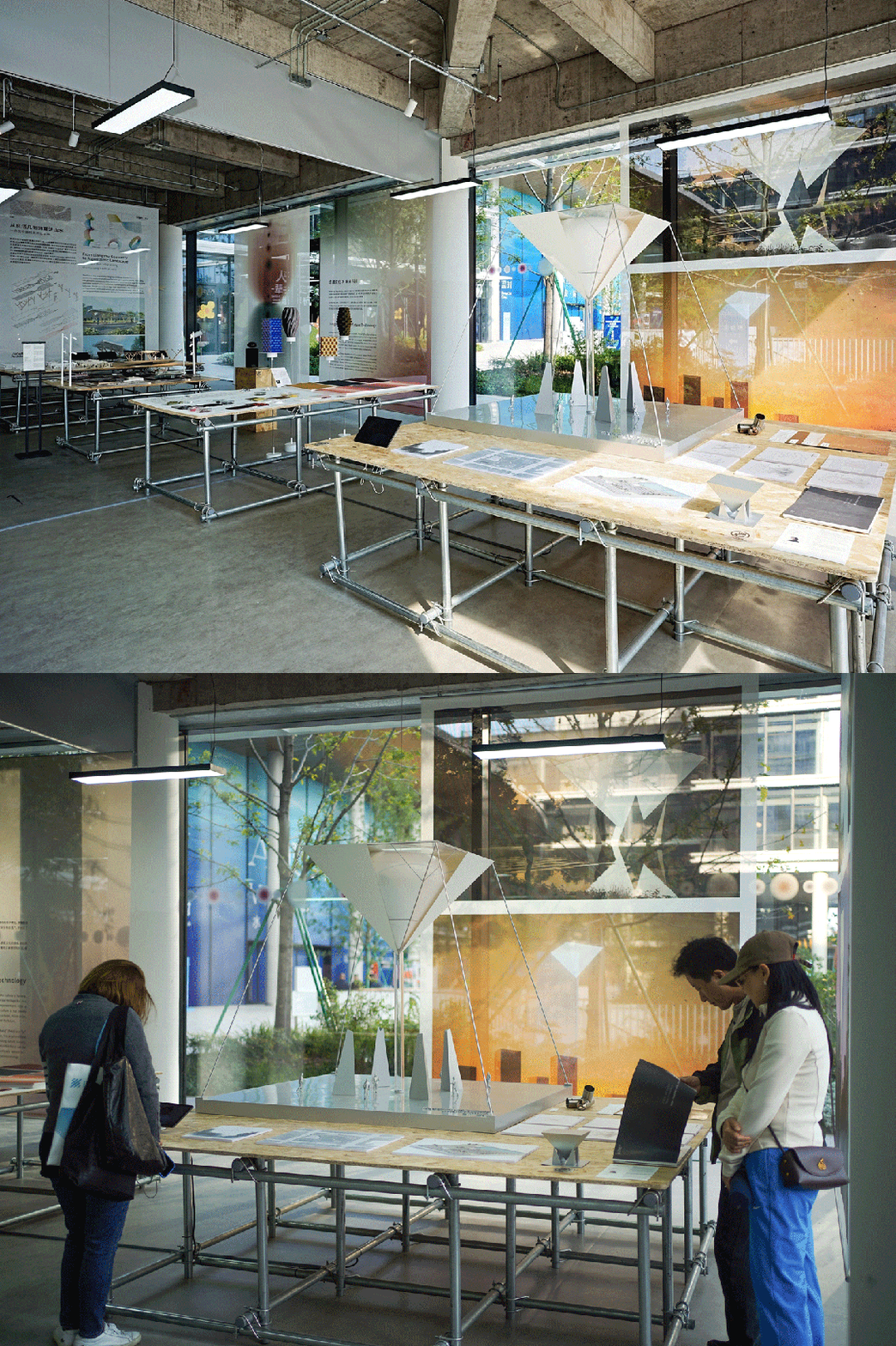
△ Model
Four stainless-steel mirrored support frames stand in stark contrast to the smooth, lightweight monumental skin, creating a non-ordinary presence within the Central Axis landscape. The installation appears almost as a foreign object descending into the site, intensifying its visual impact as an “alien” arrival.
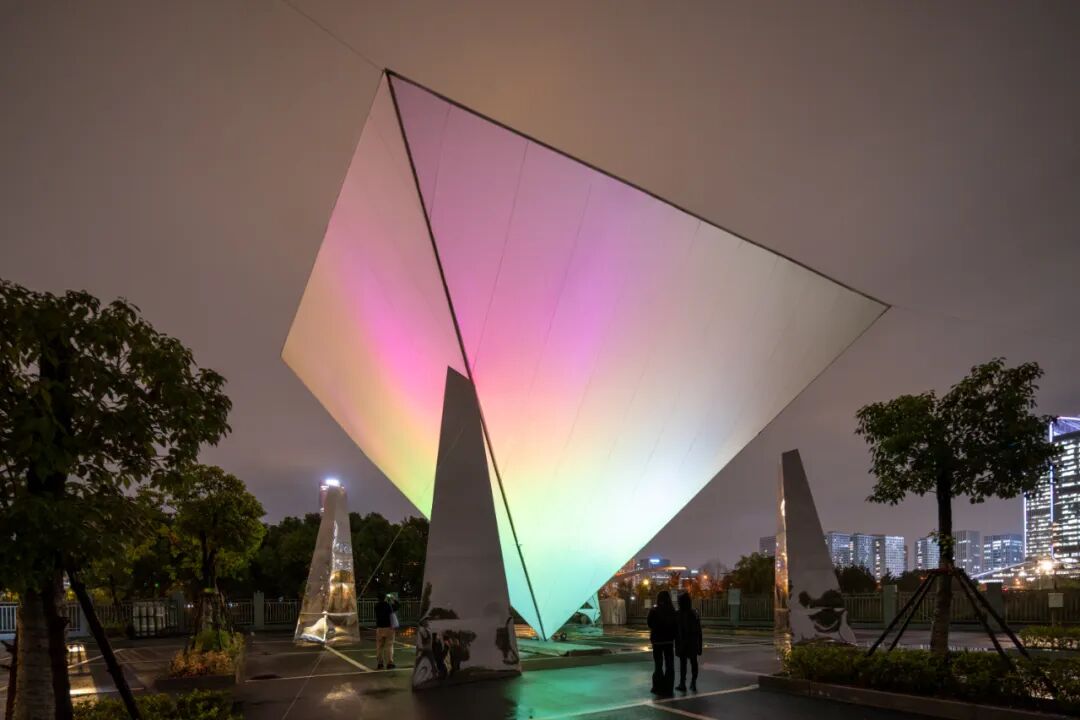
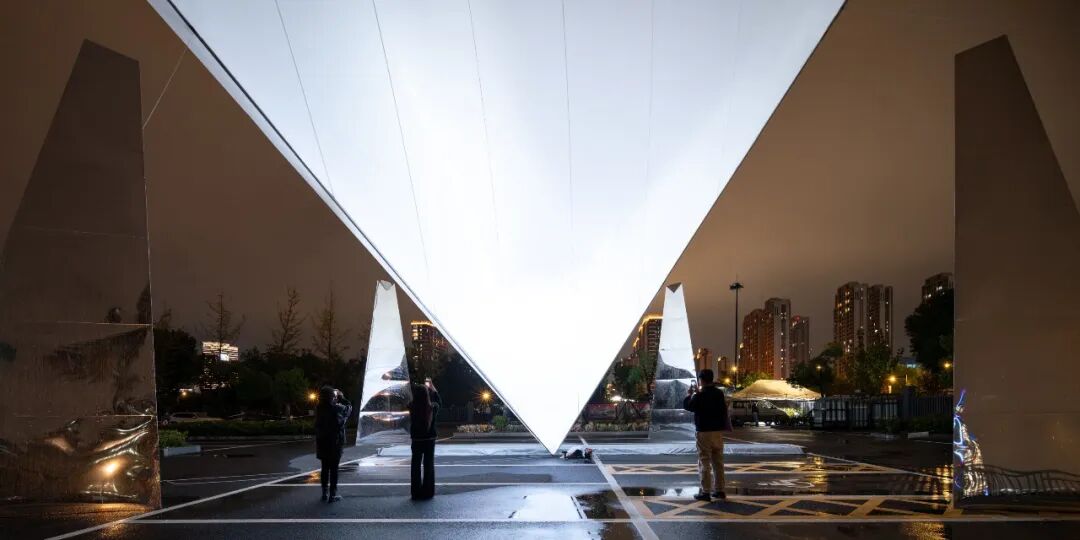
In its ground state, the structure hovers just above its base in a condition of near-floating suspension. This “almost-touching” posture dissolves the heaviness of traditional monuments while simultaneously implying an upward trajectory and latent kinetic energy. The visual defiance of gravity resonates with the scale of future landmarks and allows the public to pre-experience the area’s prospective urban vision during its developmental interlude.
| Cloud Coordinate: Suspended Imagination
If the Tower of Light operates as a static sculpture on the ground, its ascent into the air transforms it into the Cloud Coordinate. This shift represents a fundamental reorganization of the relationship between object and city. In a state of radical lightness, architectural “stability” is replaced by fluidity, marking a transition from a ground-bound landmark to a momentary, floating, and even immaterial urban reference.
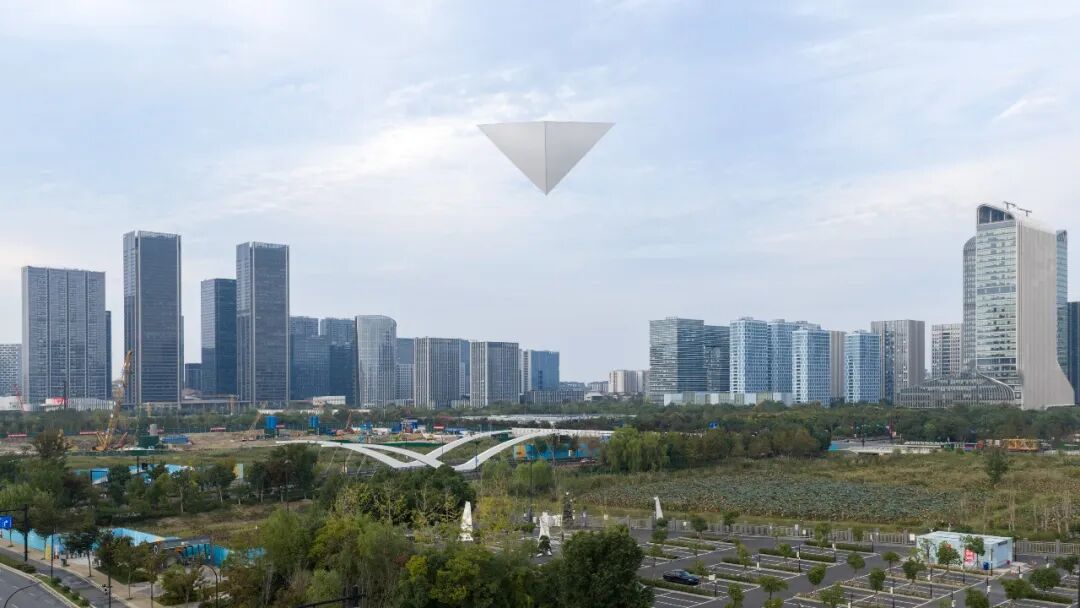
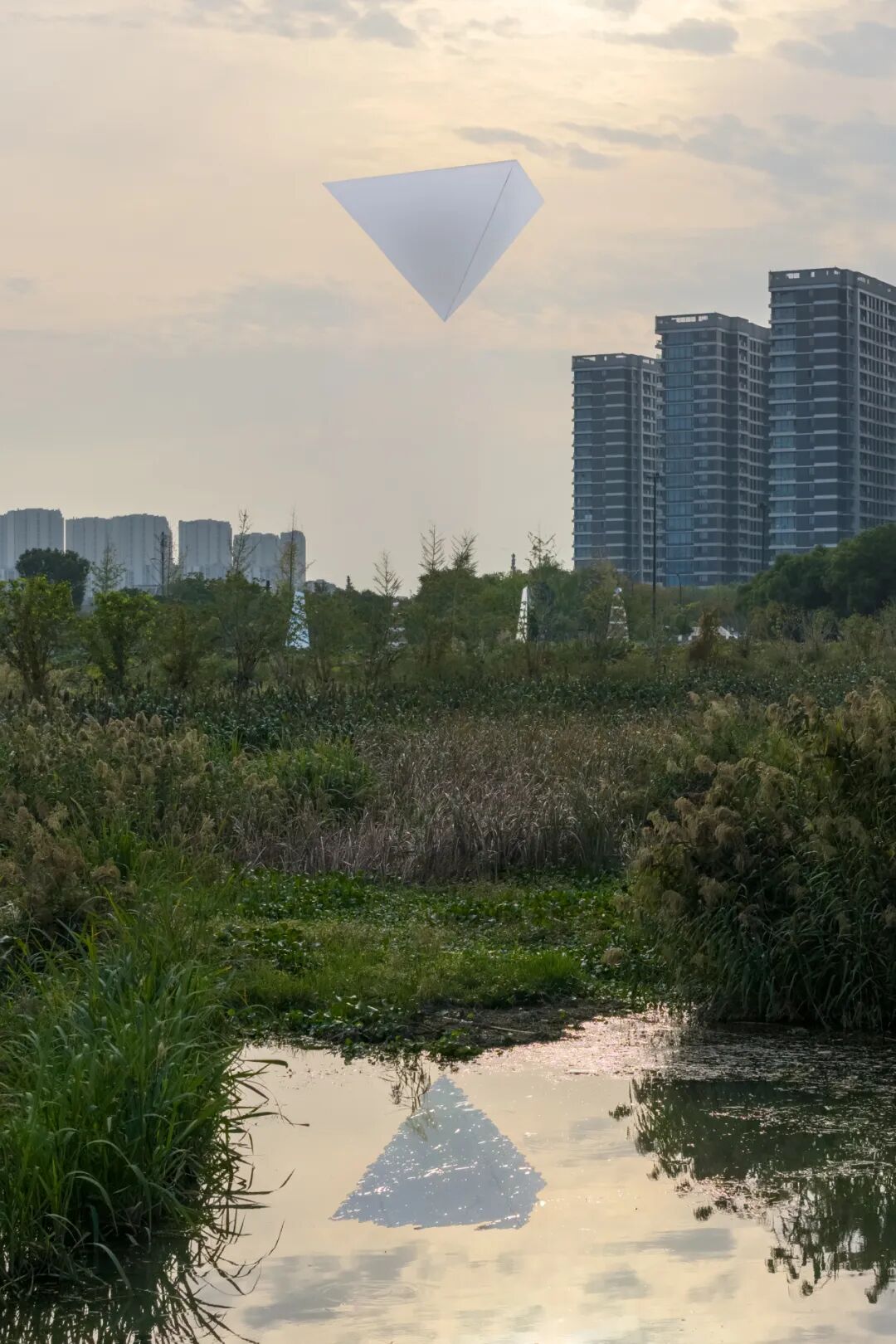
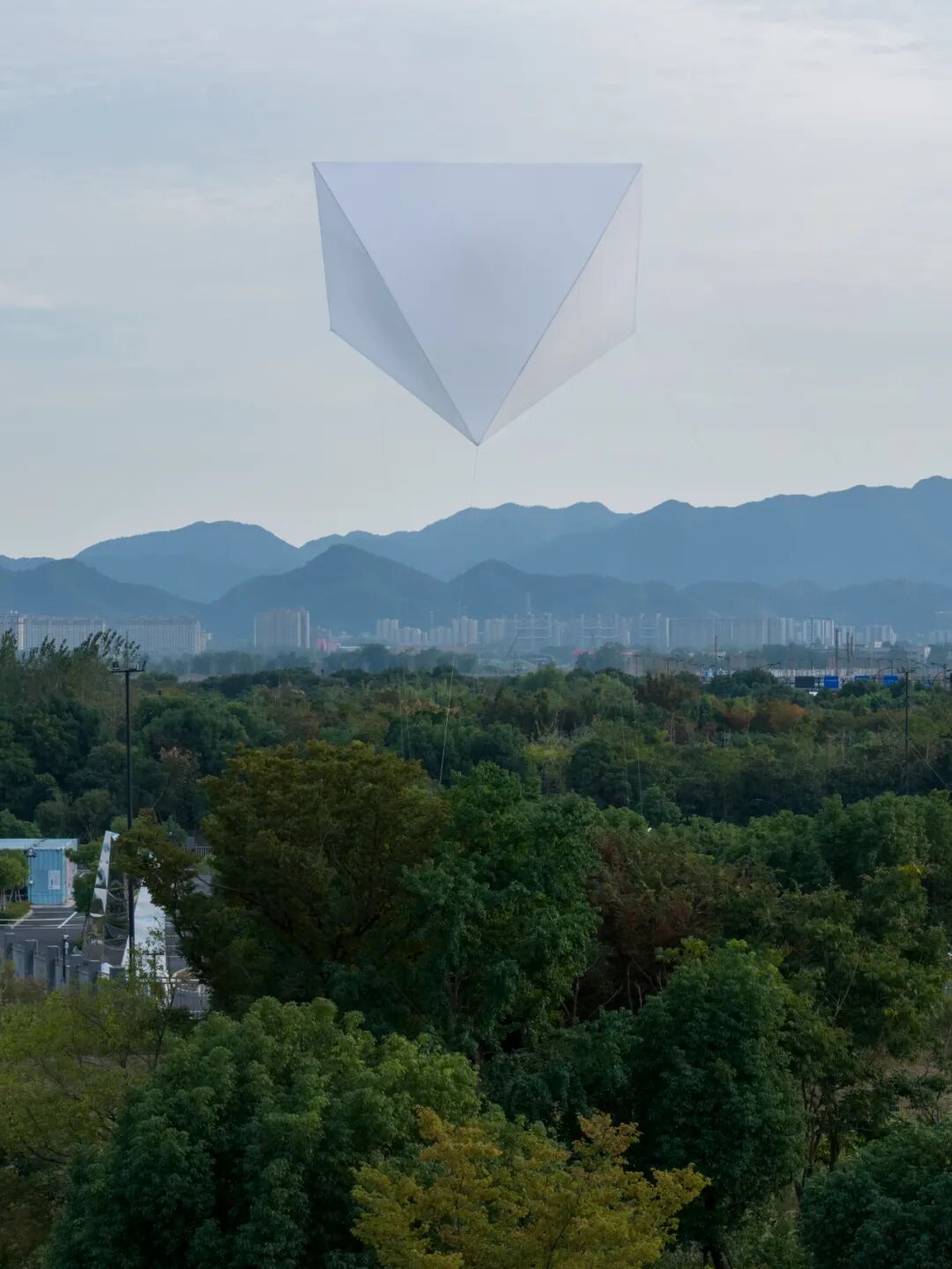
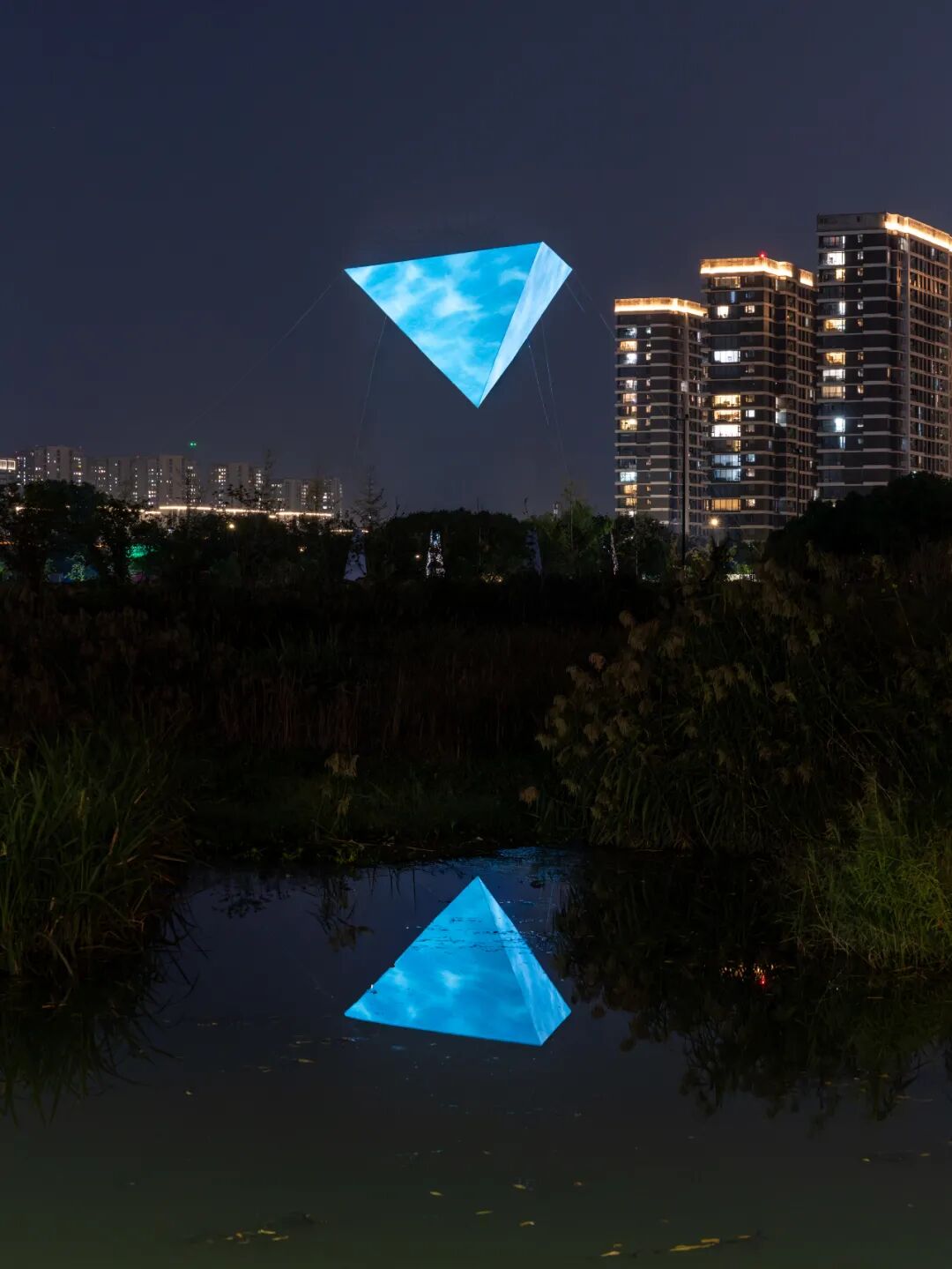
At full ascent, the installation reaches a height of up to 80 meters, completely detaching itself from the ground. Supported by aviation-grade lifting and stabilization systems, it functions as a dynamic coordinate that responds in real time to environmental conditions and information flows—staging a speculative rehearsal of the city’s future above the Central Axis.
The realization of Future Cloud Coordinate is fundamentally driven by the liberation of design imagination through material innovation and construction logic. Achieving a suspended form that is both lightweight and stable required the design team to simultaneously address challenges related to weight control, structural integrity, and wind resistance.
To subvert gravity while maintaining formal rigidity, the design abandons conventional steel structures in favor of carbon-fiber composite materials, whose exceptional strength-to-weight ratio provides the technical foundation for this suspended architectural experiment.
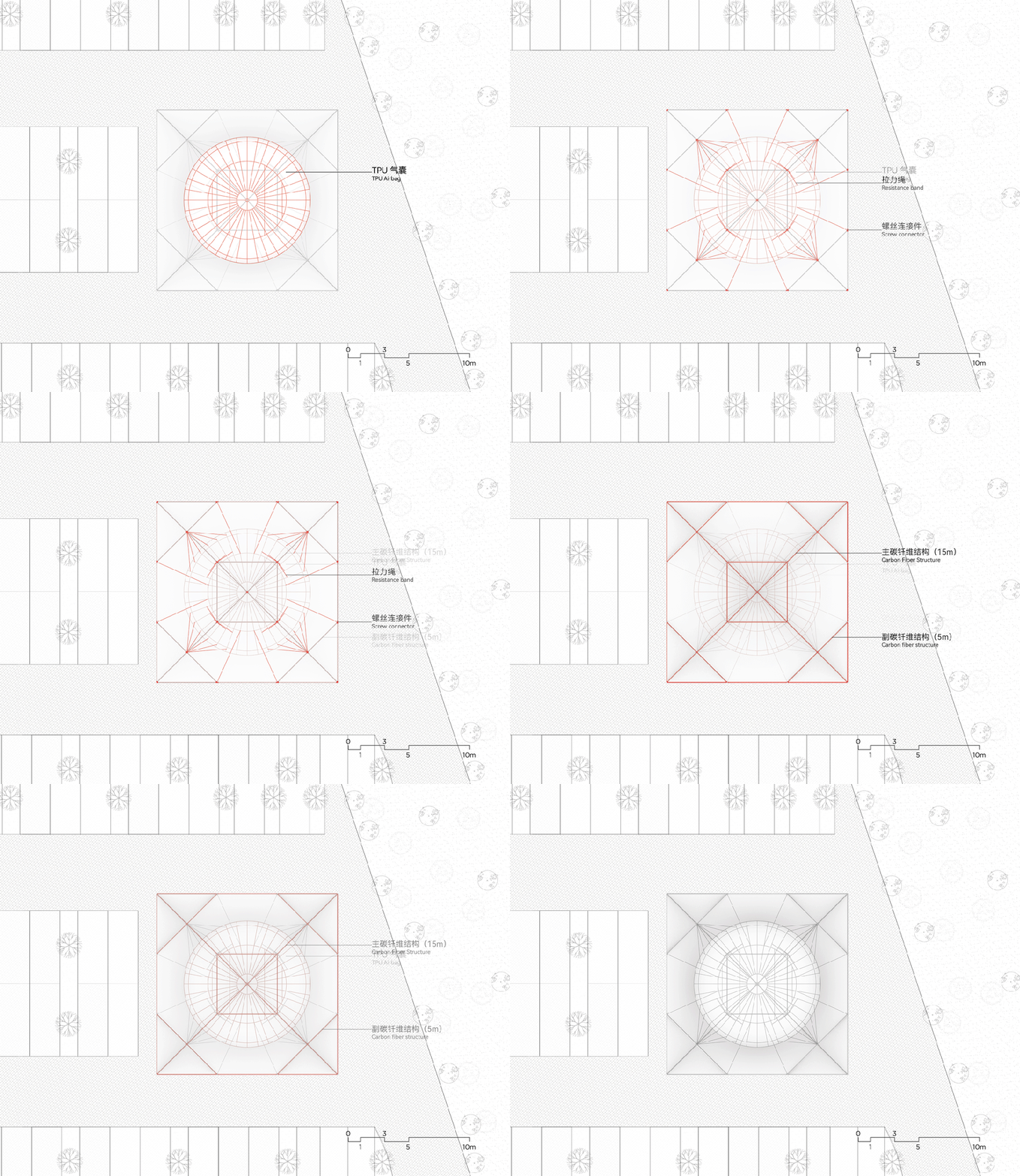
△ Plan Structural Analysis
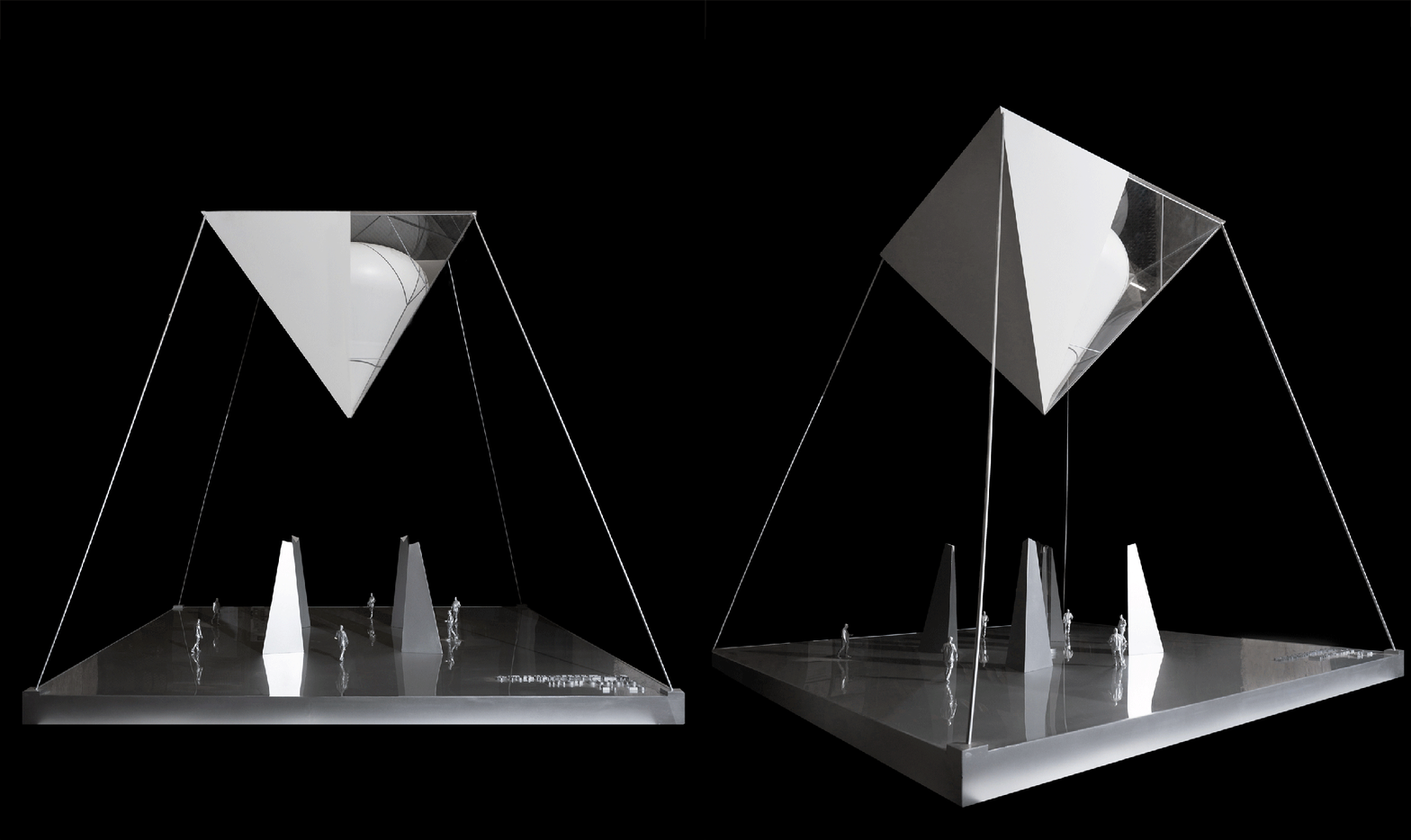
△ Model
With a precise target of lift-to-mass ratio ≥ 1.2, the system allocates approximately 500 kg of total lift to support 420 kg of structural weight, reserving 80 kg as a safety margin. This ensures that the installation maintains its large-scale visual presence while meeting the physical requirements for ascent.
This logic extends across all structural layers. Occupying a spatial volume of approximately 490 m³, the installation responds to aerodynamic constraints with extreme material efficiency:
– Internal air bladders with a surface area of ~340 m², weighing ~100 kg
– External membrane covering ~520 m², weighing ~60 kg
– A 208-meter carbon-fiber support system, weighing ~170 kg, providing geometric rigidity and wind resistance
Together with metal connectors, electronic components, and cable systems, the total weight is compressed to the critical threshold required for lift-off.
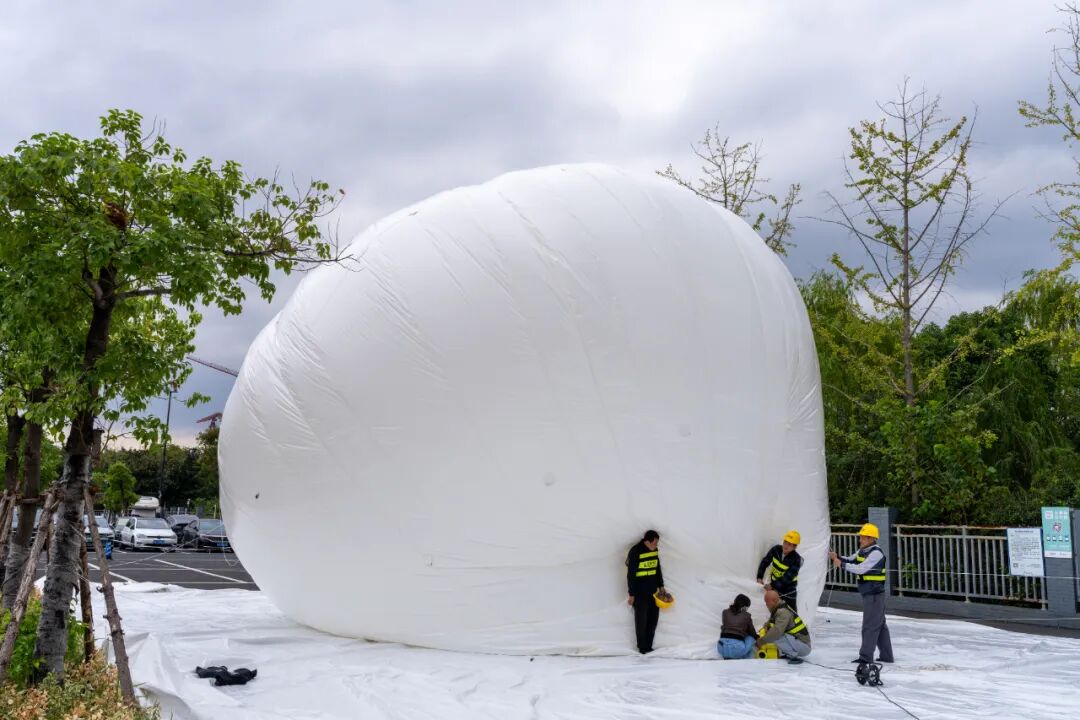
△ Air Bladder Testing
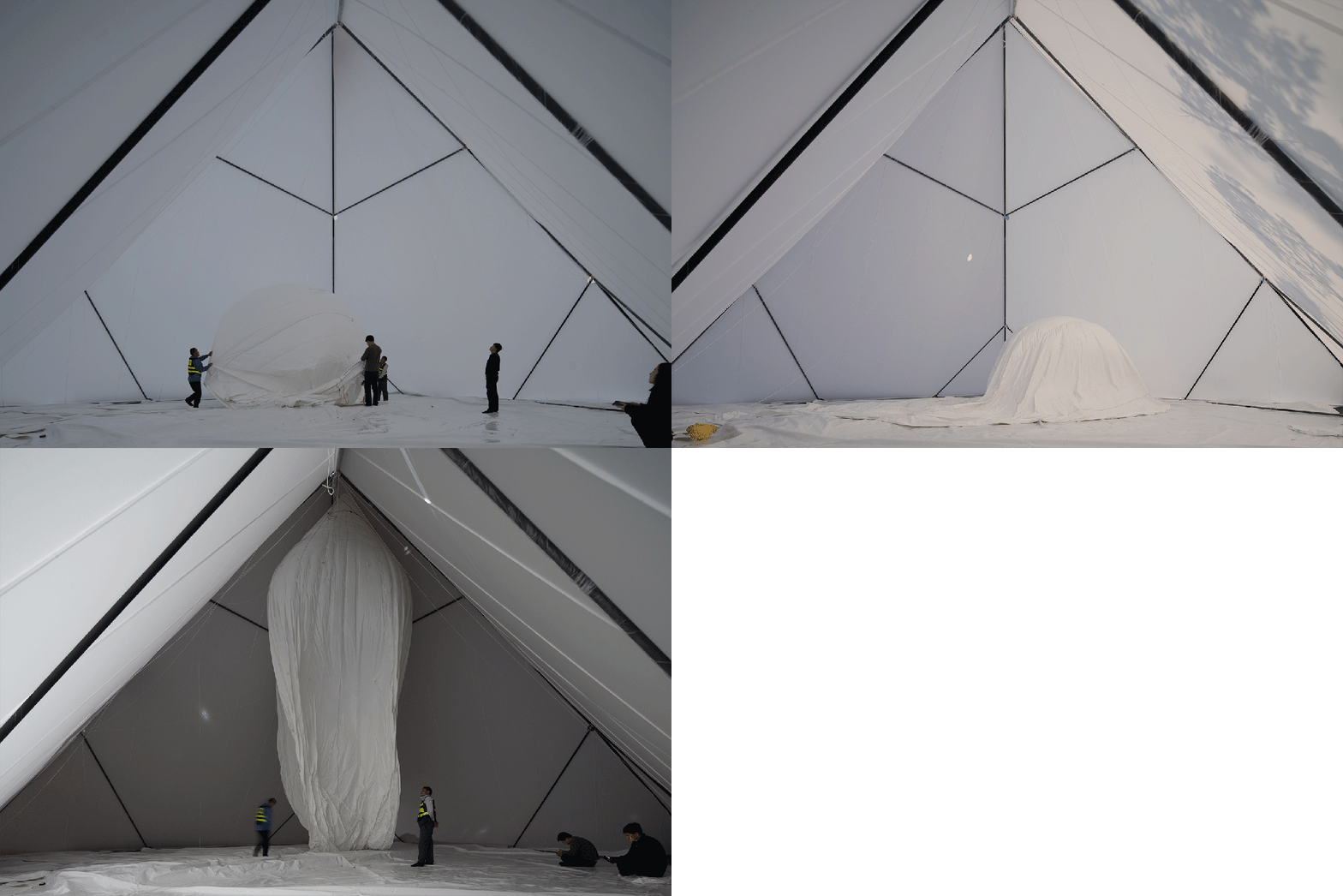
△ Air Bladder Inflation Process
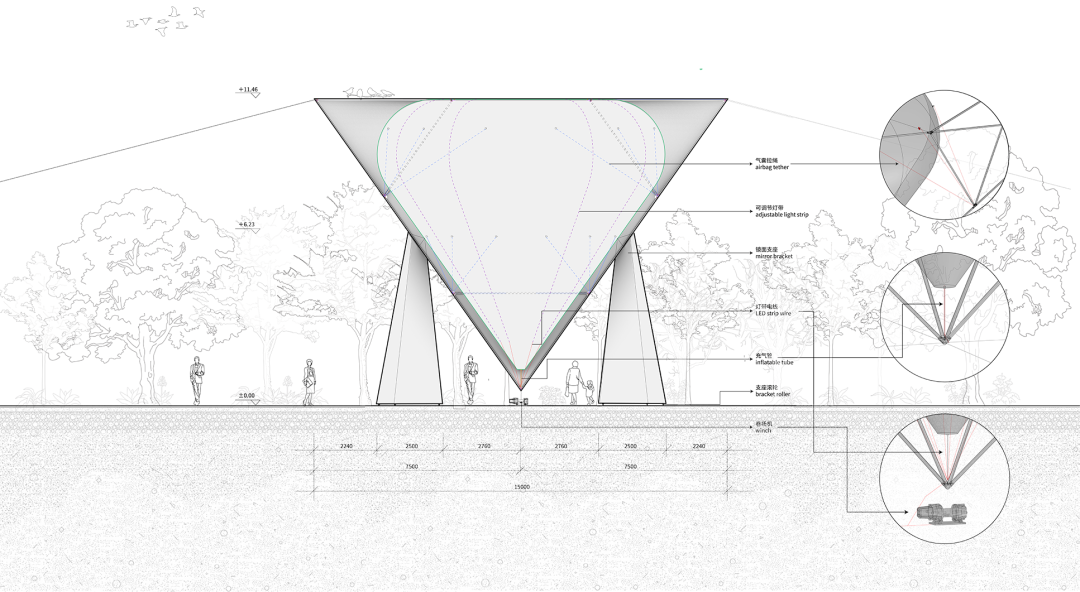
△ Sectional Analysis
Unlike conventional aerostatic installations, the challenge of Future Cloud Coordinate lies not in floating itself, but in maintaining architectural formal clarity while airborne. Compared to typical inflatable structures, its surface and structural components are significantly heavier to ensure smoothness and volumetric legibility. It is precisely this meticulous distribution of weight and material selection that allows the installation to present a restrained, architectural presence in the air, achieving a high degree of coordination between structural rationality and aerodynamics.
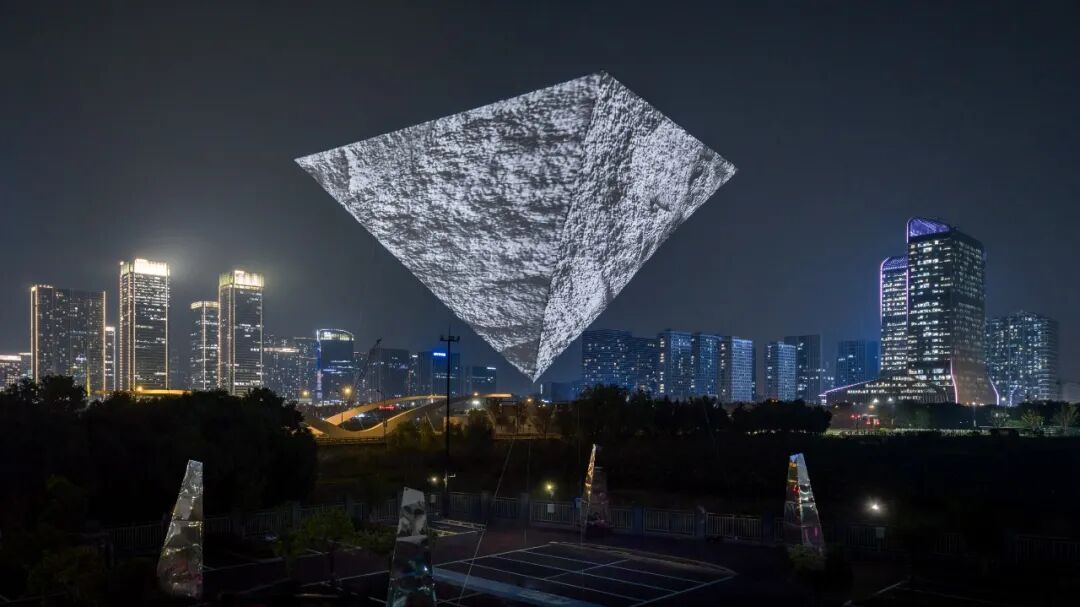
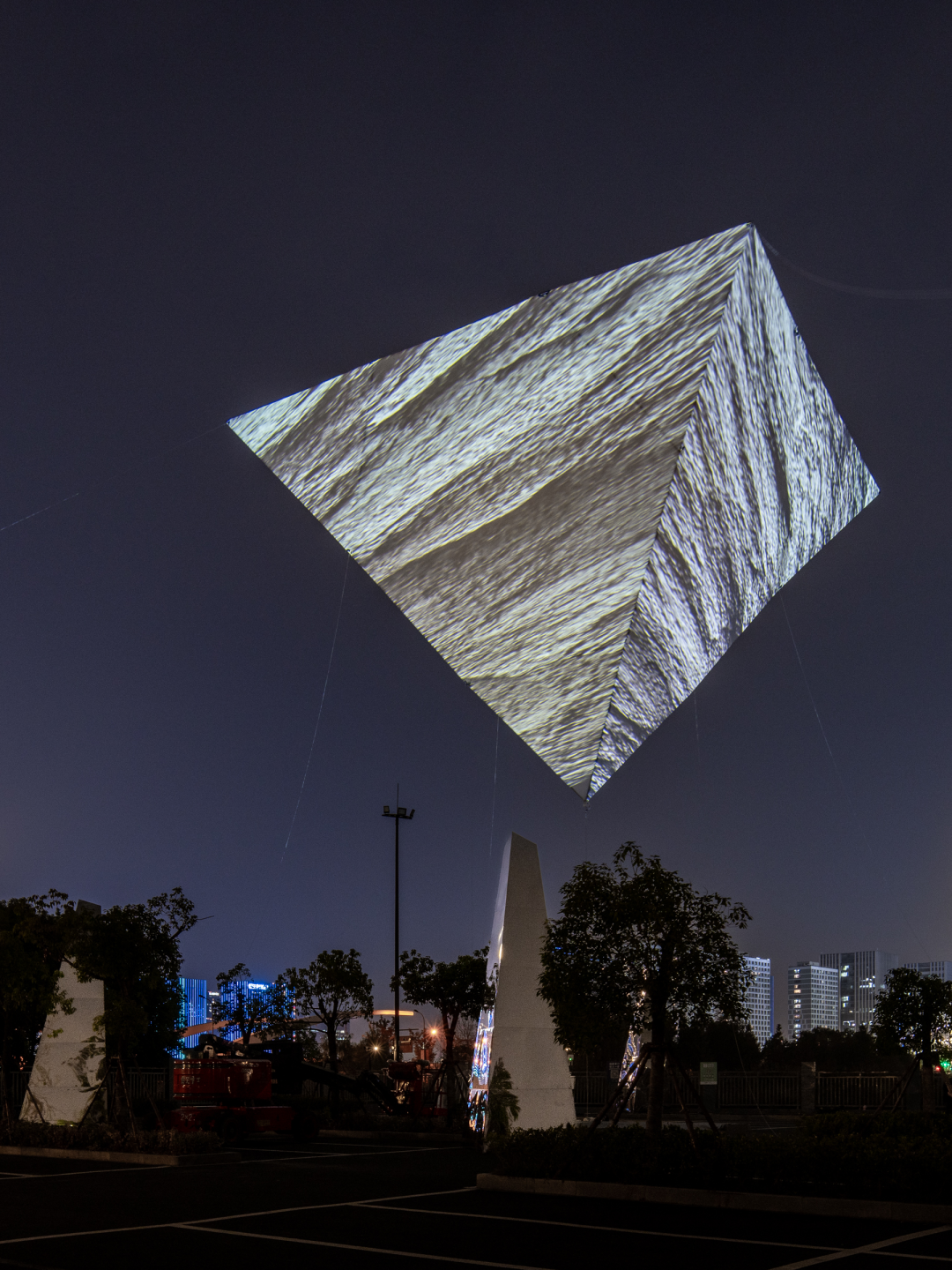
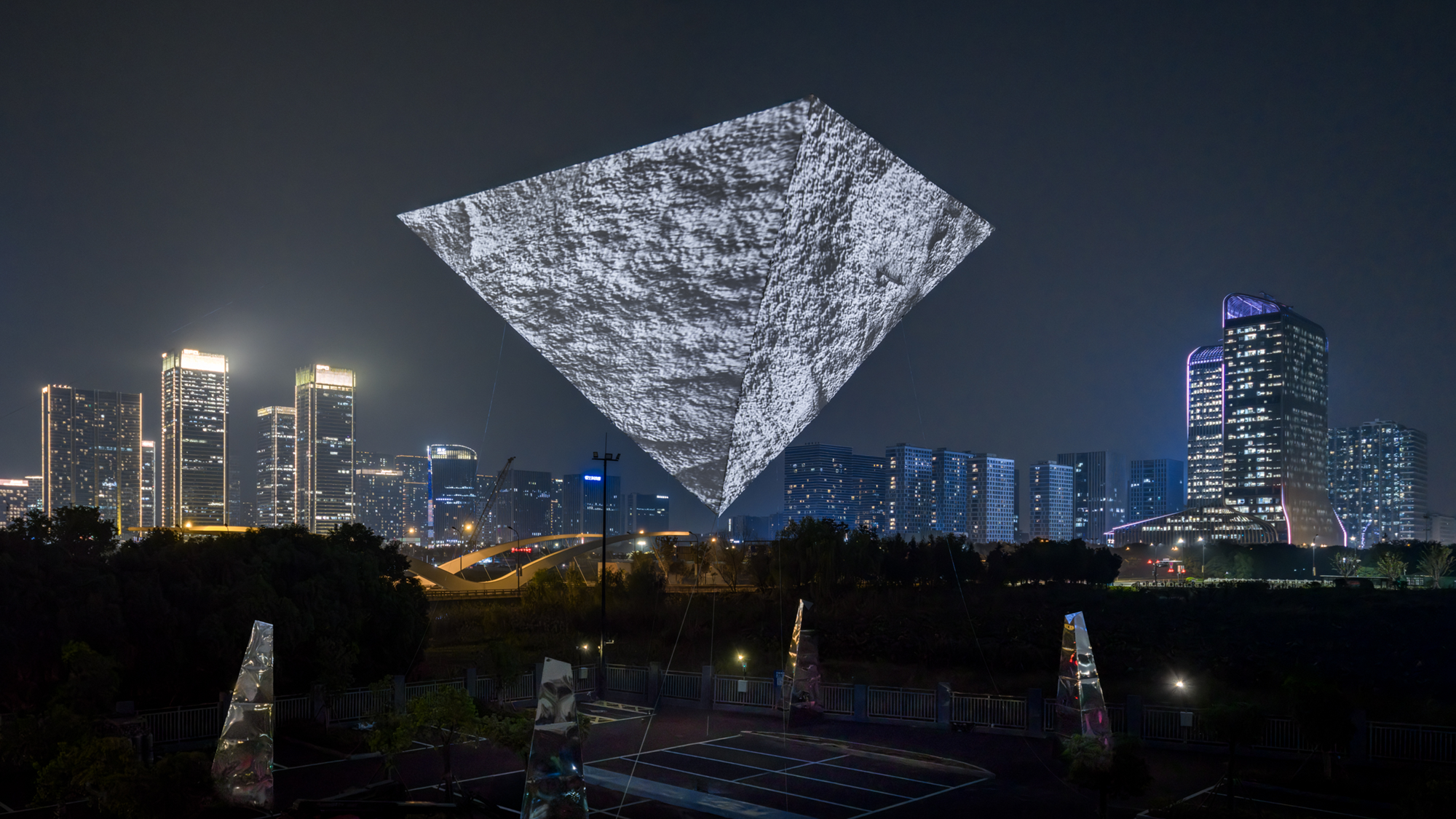
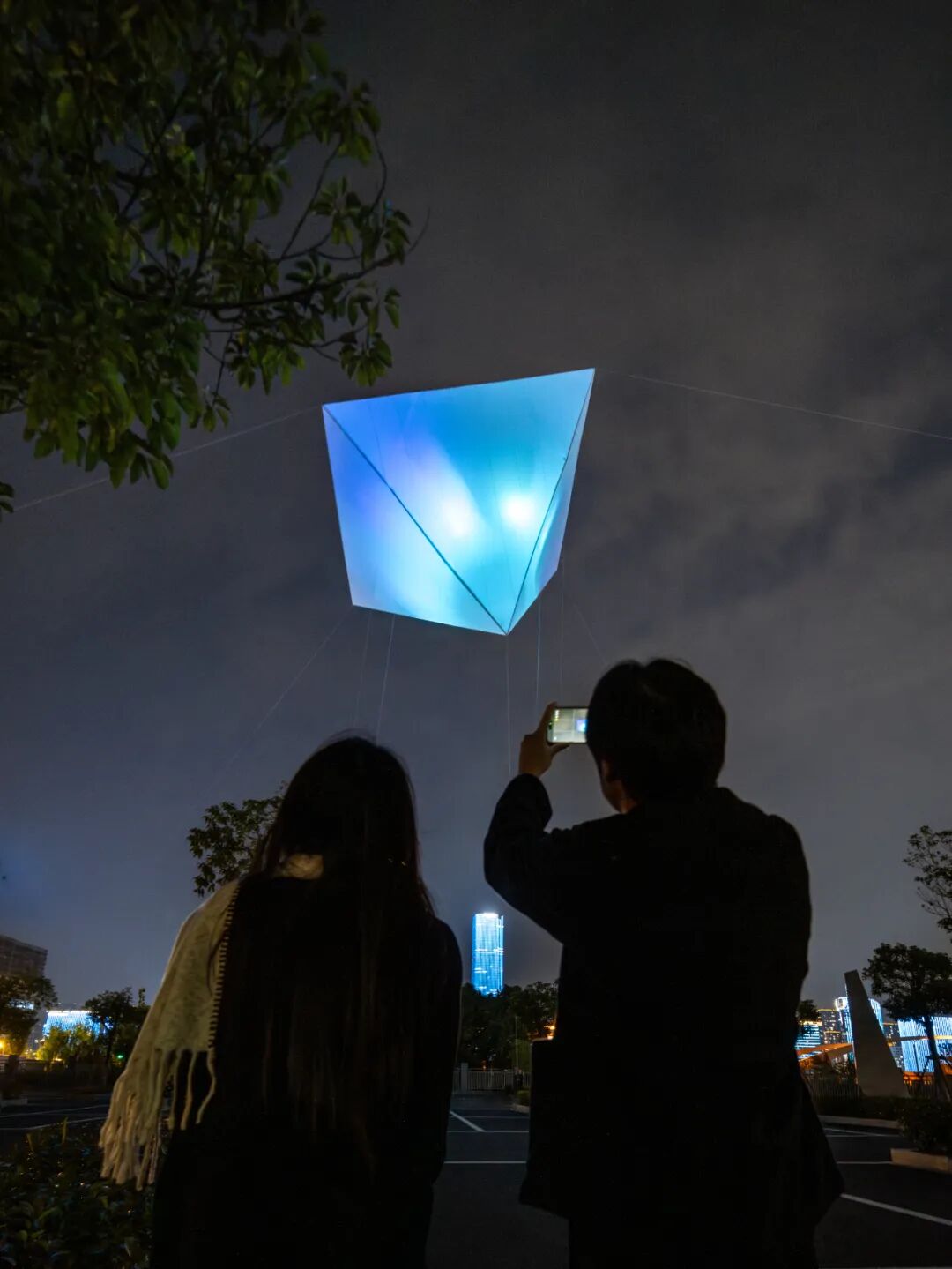
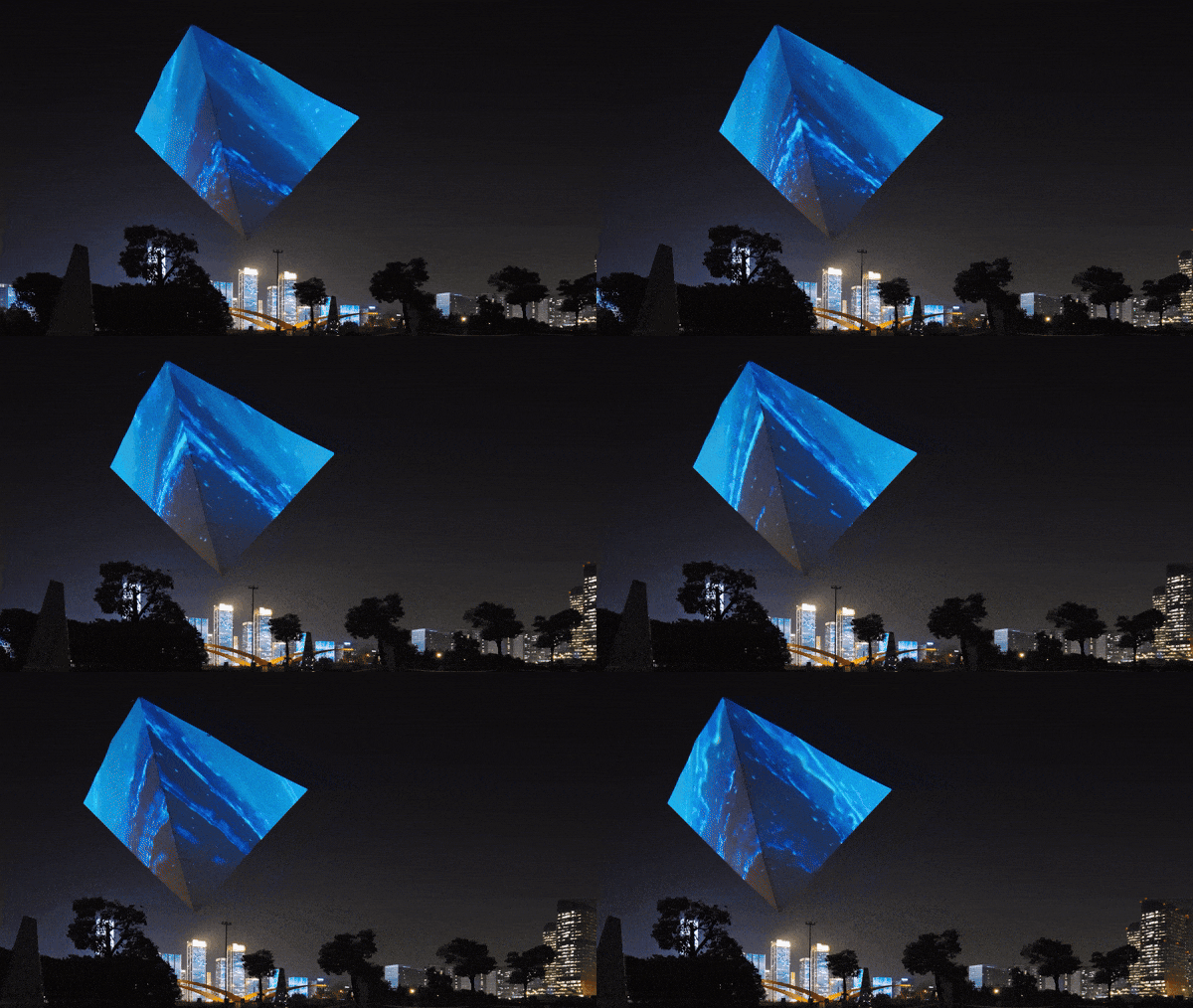
Eight 10-meter RGBW programmable light strips (total power 640W) are evenly mounted around the external surface of the internal air bladders. Two diagonally positioned projectors cover adjacent faces, ensuring full-surface projection without blind spots. Controlled remotely, the system produces continuously evolving optical effects across different states, reinforcing the installation’s role as a perceptual urban medium.
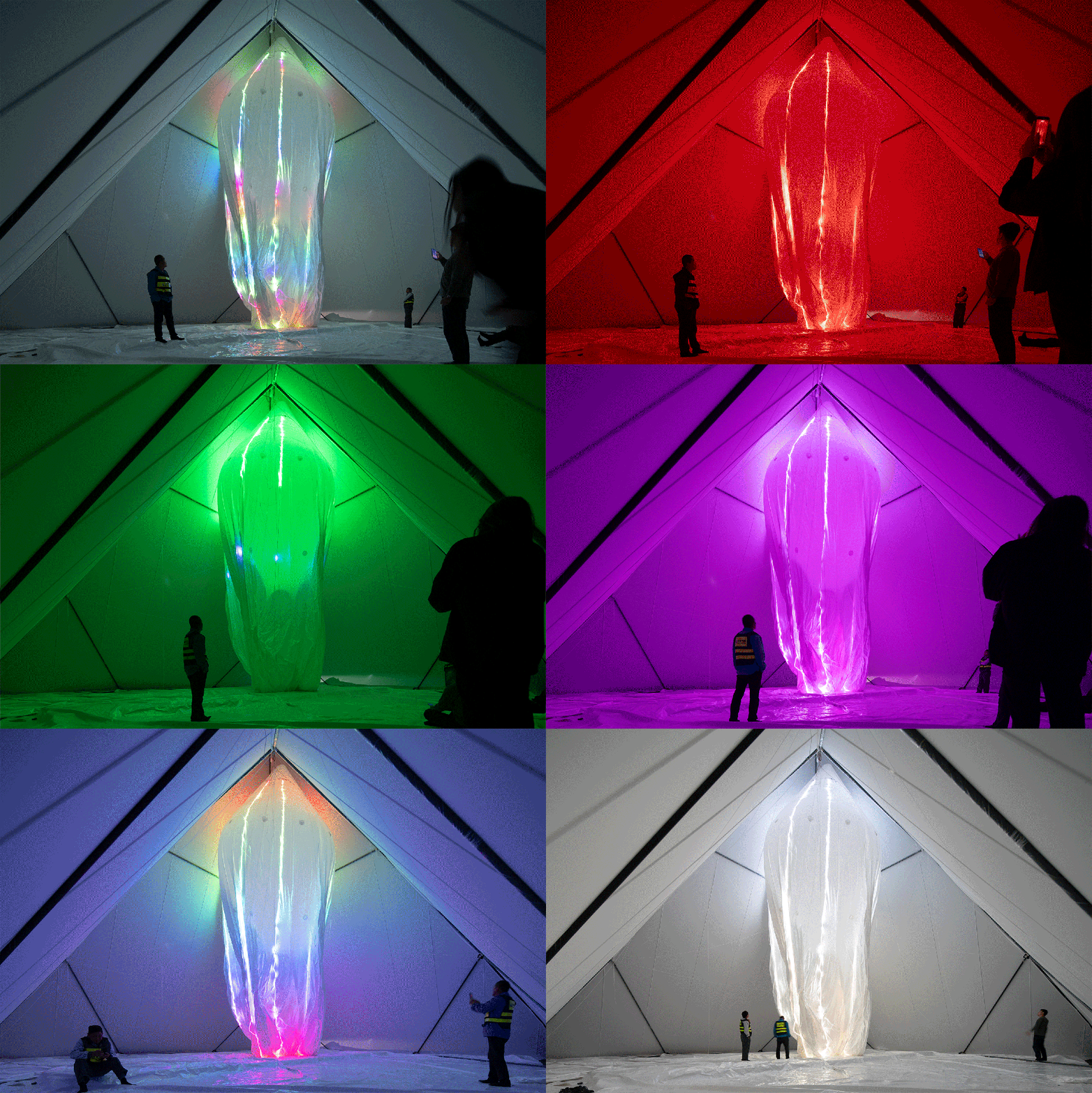
△ 灯效测试
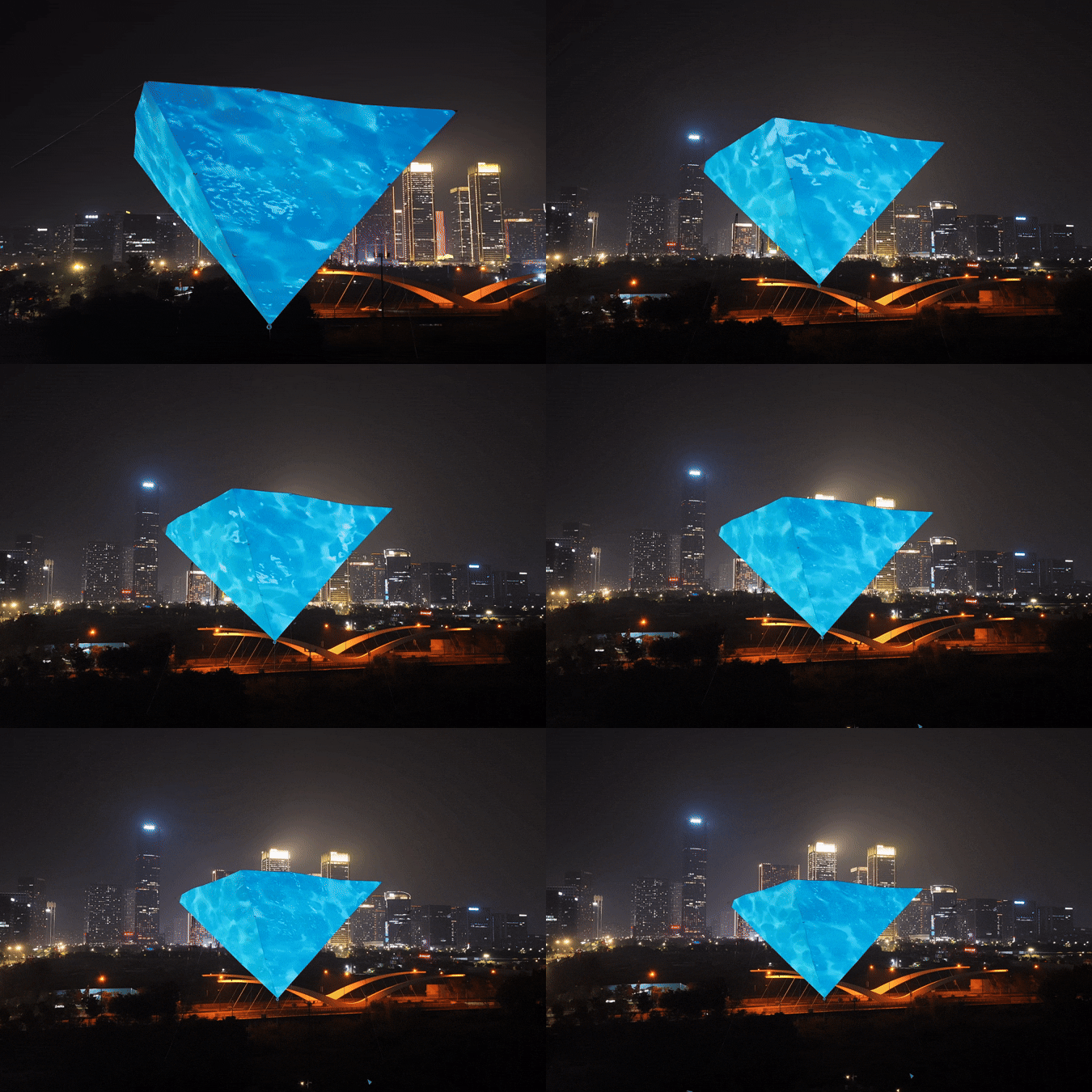
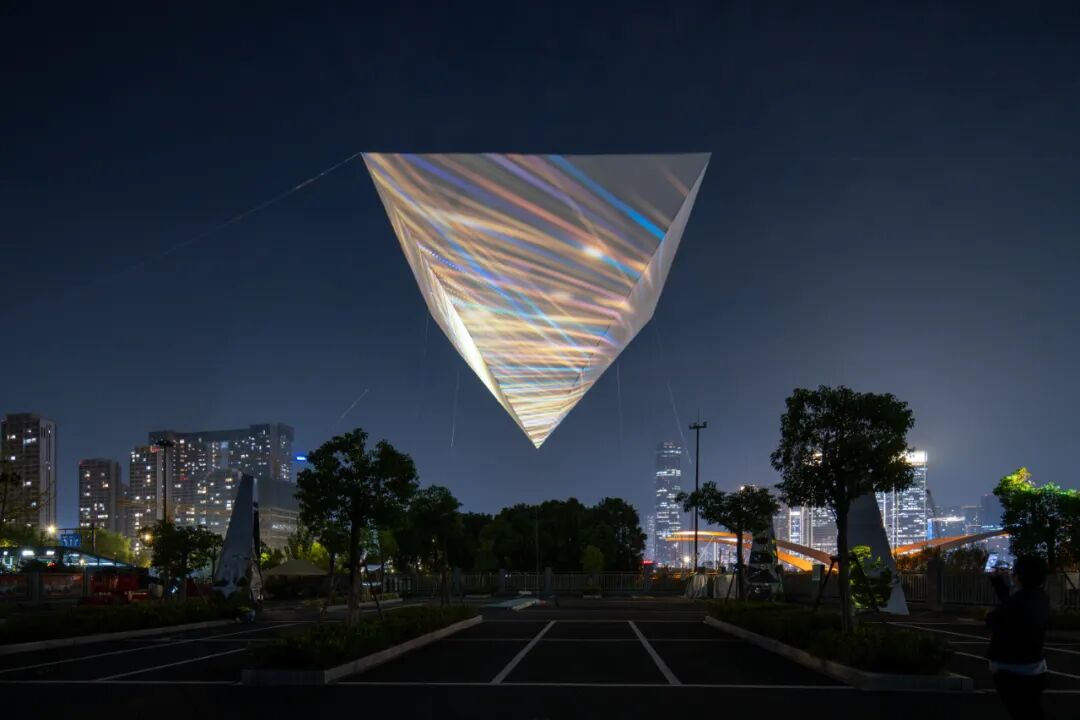
On site, the installation was first assembled on the ground in an upright pyramid configuration, then inverted as a whole to form the Tower of Light. Finally, through the precise balance between buoyant force, self-weight, and tensile cables, it transitioned into the suspended Cloud Coordinate. The introduction of carbon fiber made this construction experiment—shifting from gravitational anchoring to anti-gravitational intervention—physically feasible.
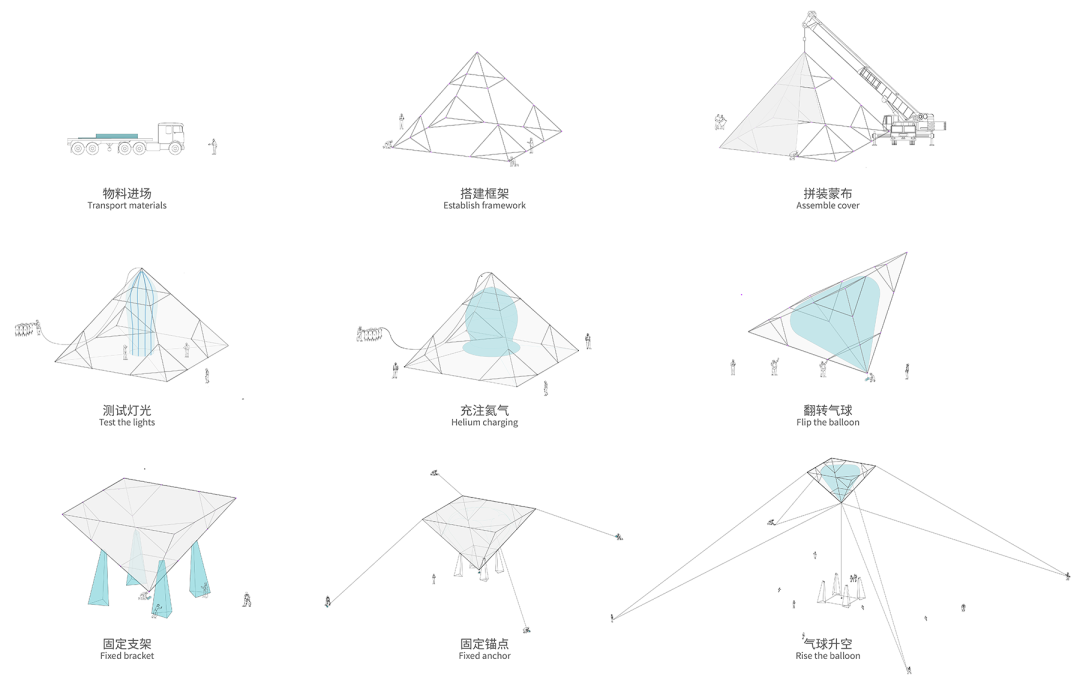
△ Construction Process Diagram
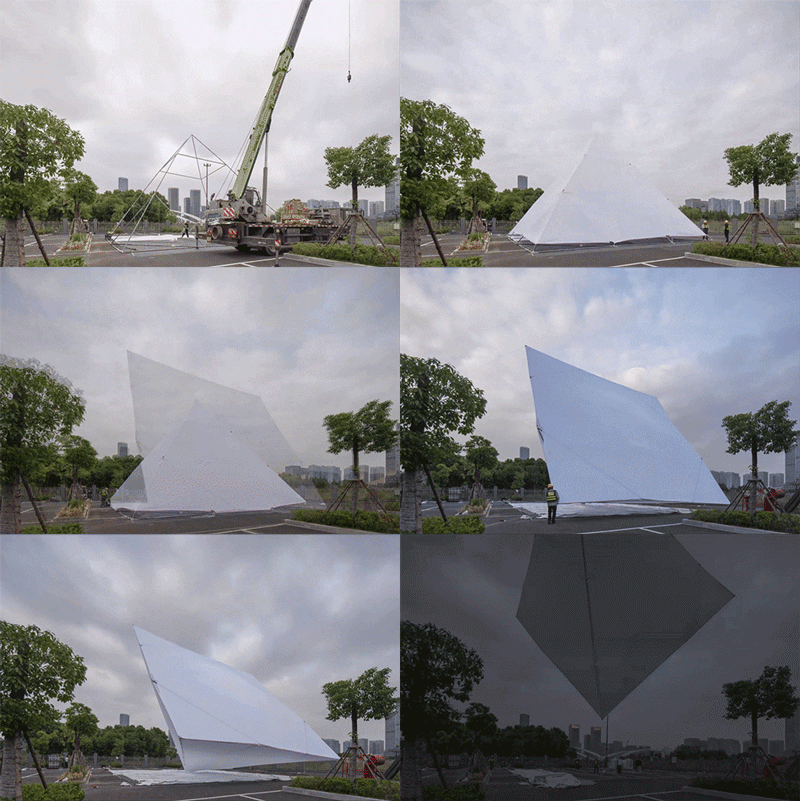
△ On-site Assembly Process
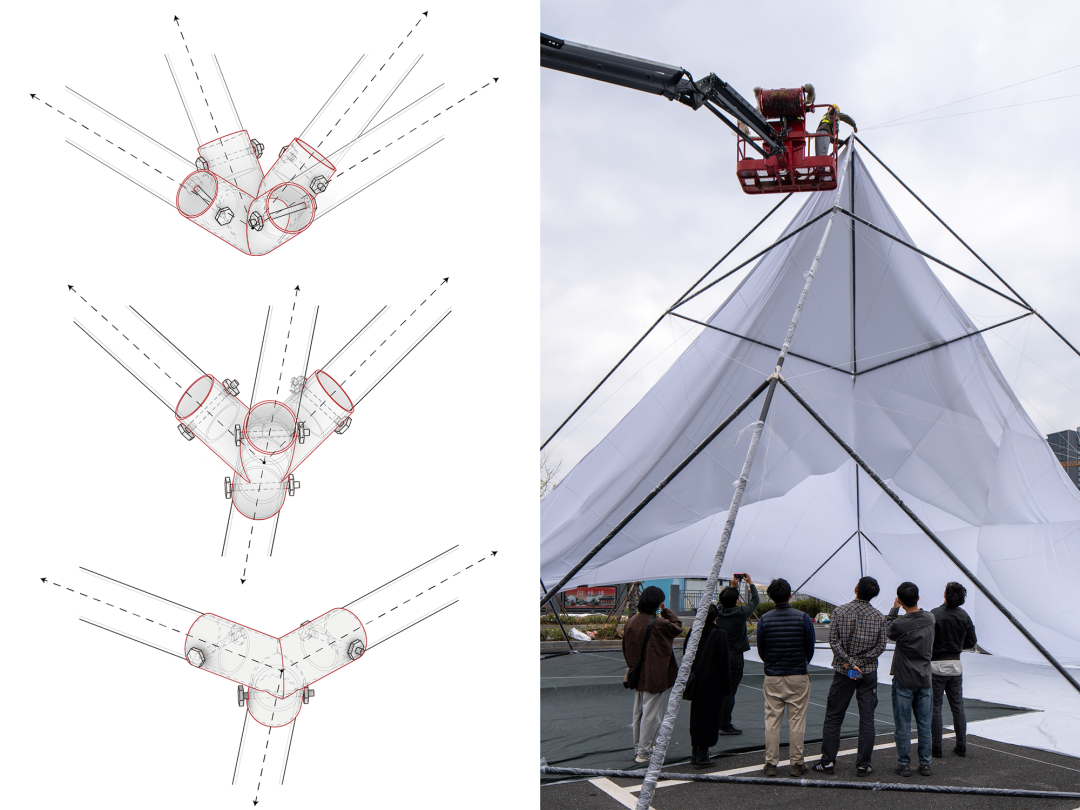
△ Carbon-Fiber Connection Node Diagram
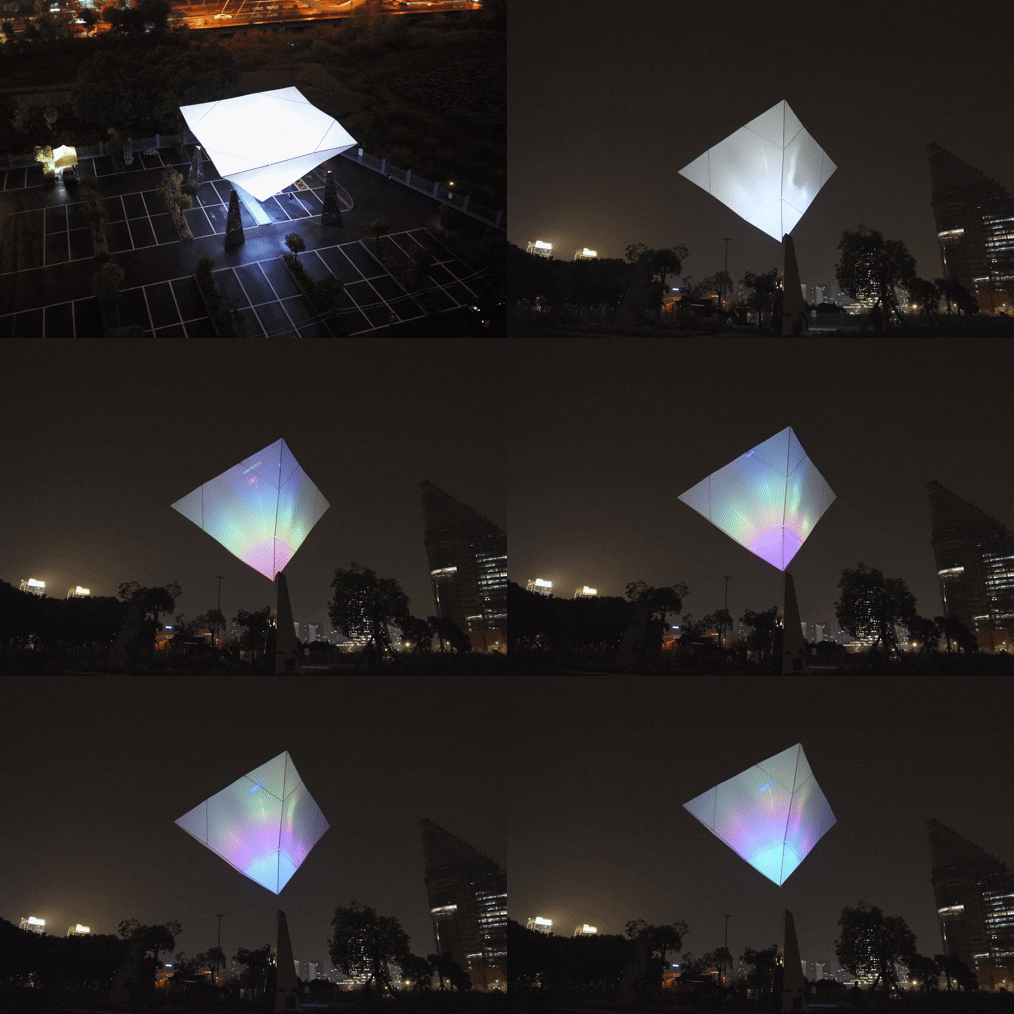
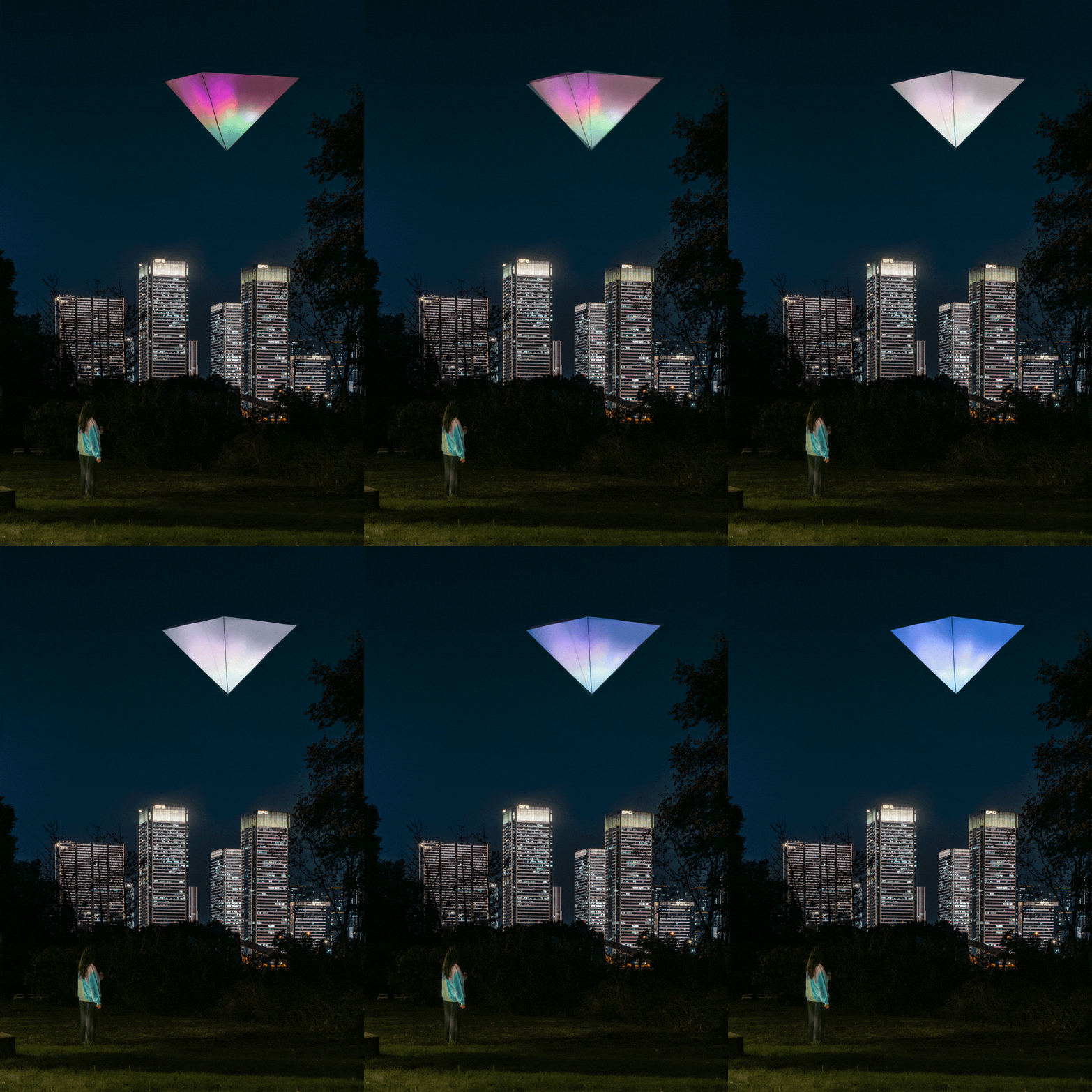
At night, the installation’s physical boundaries are continuously dissolved through projections and light. The object is no longer perceived as a solid occupying space, but as a mediated urban interface that can be observed, interpreted, and participated in. This mediatic condition responds to contemporary spatial tendencies—where material presence recedes and information emerges. Flowing colors juxtapose Liangzhu civilization with contemporary technology, transforming the installation into a perceptual medium connecting past, present, and future.
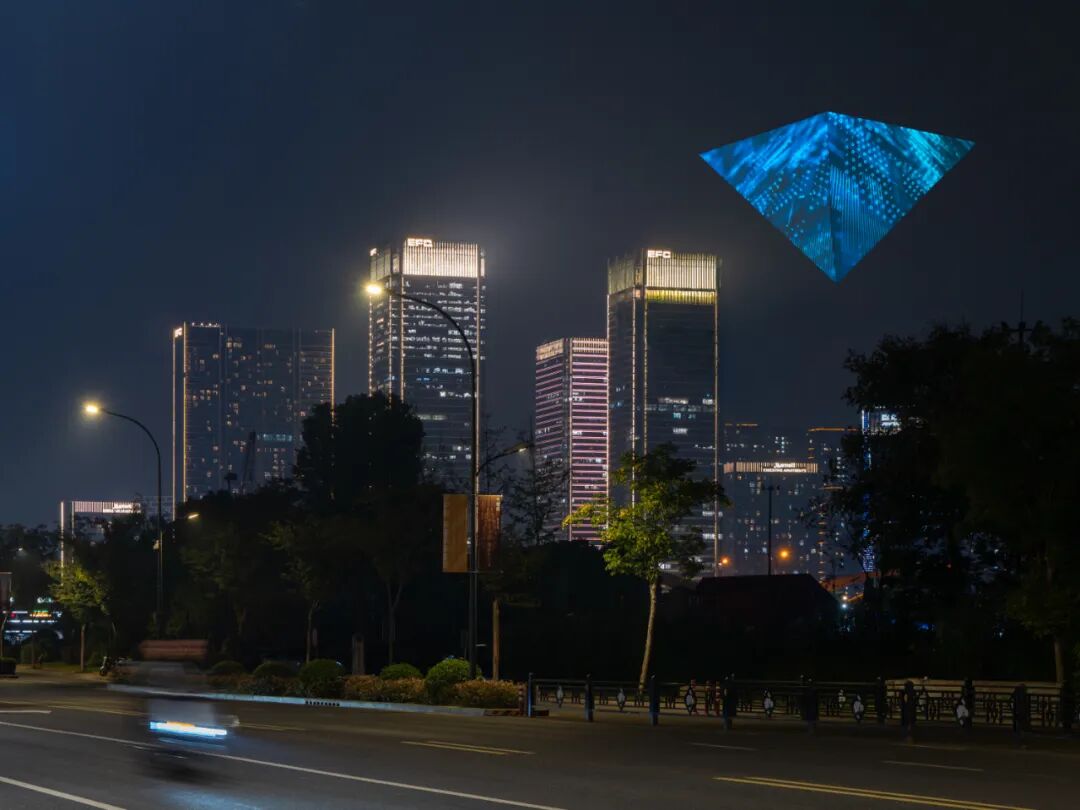
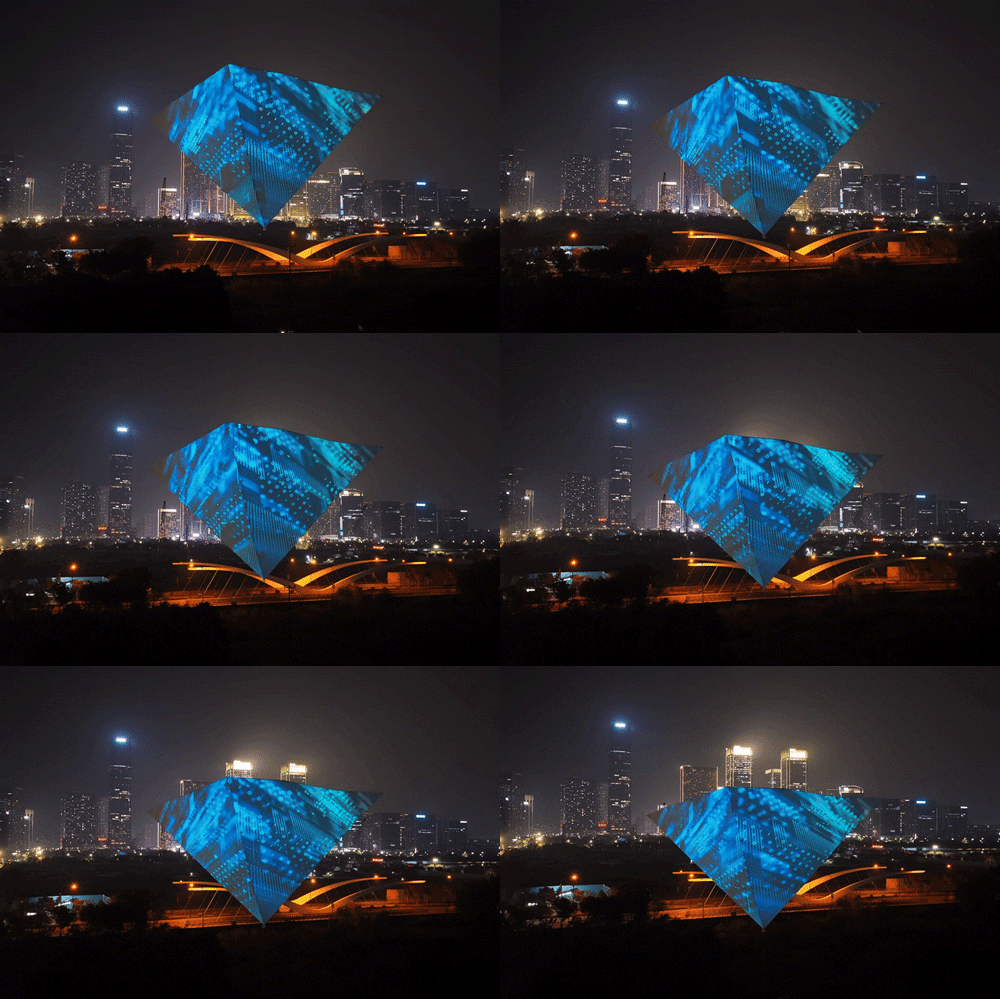
As the Tower of Light transitions from a static ground marker to the airborne Cloud Coordinate, its role undergoes a complete translation. Modes of viewing shift, and new forms of interaction are generated. As a micro-scale urban touchpoint, the installation does not provide a fixed form, but instead guides the public toward new spatial cognition through continuous transformation.
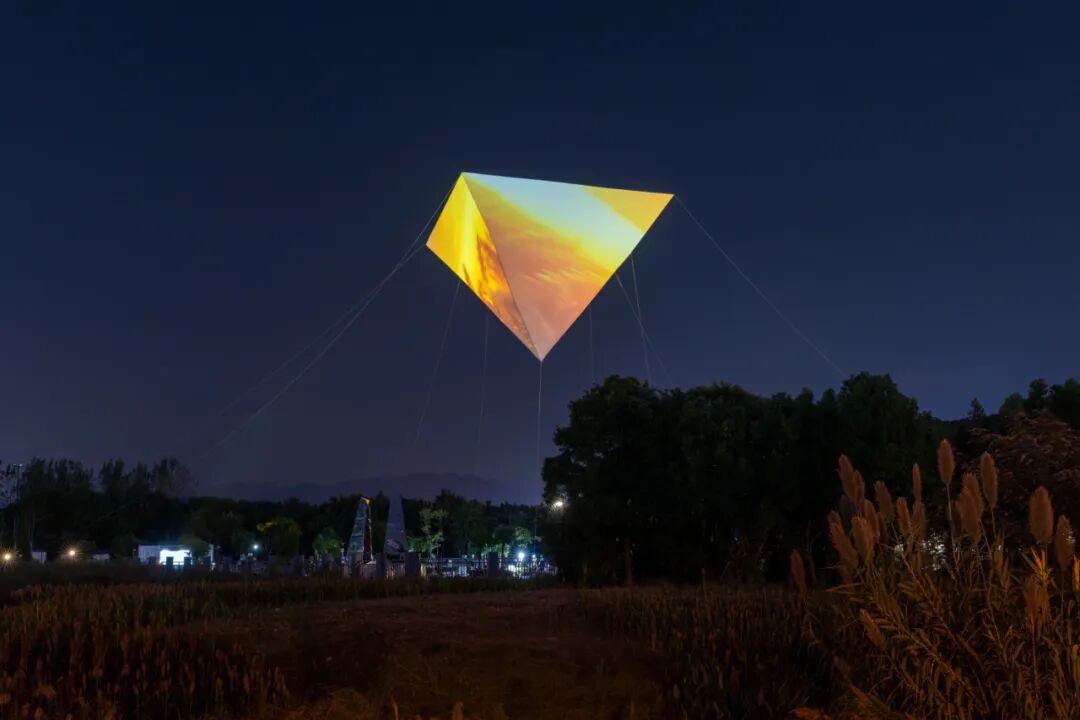
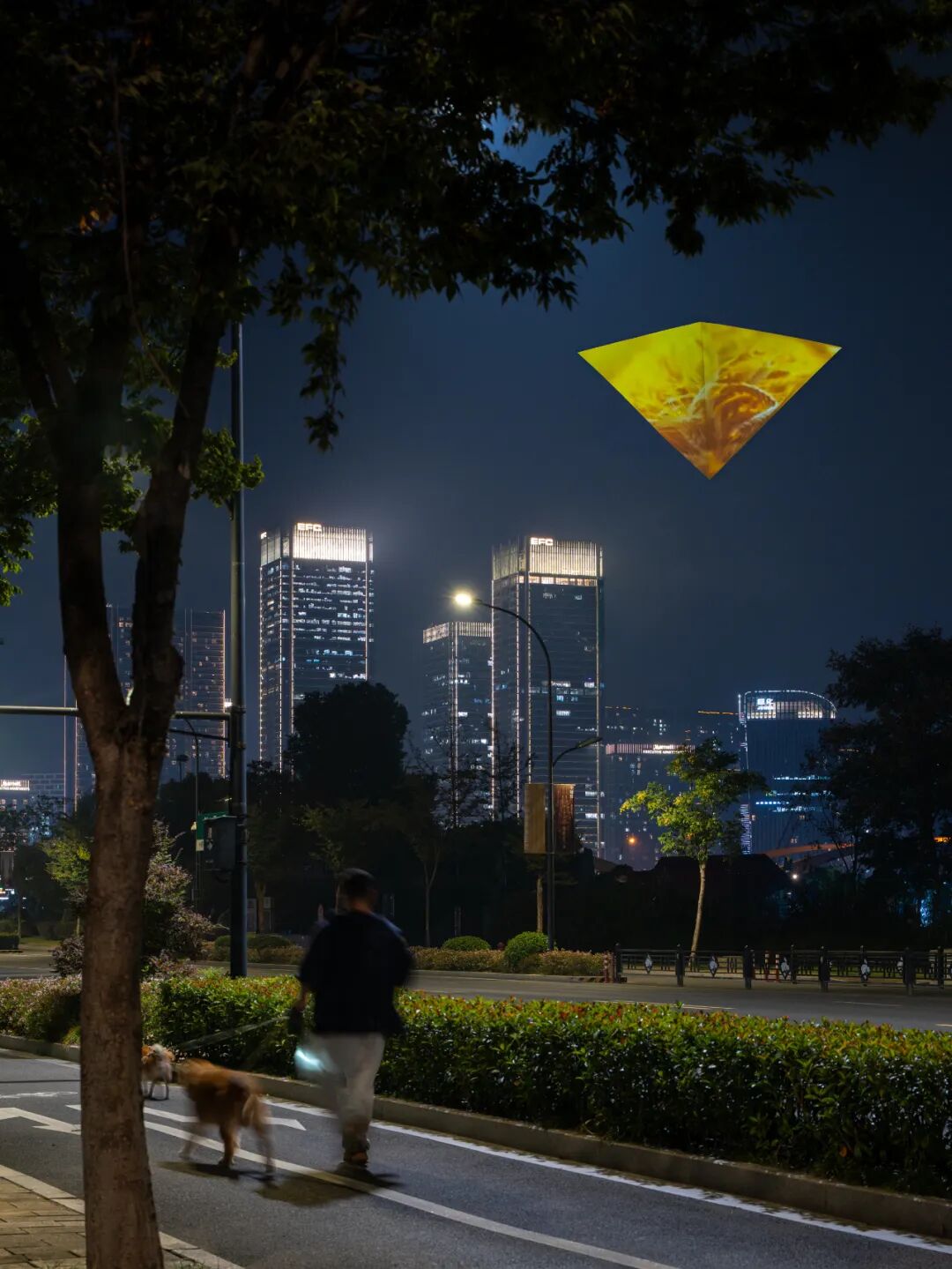
If traditional architecture is understood as providing certainty and shelter, Future Cloud Coordinate proposes an inverse practice: architecture no longer solidifies space, but becomes a dynamic medium for reconstructing relationships. Through architectural intelligence and supply-chain collaboration, it orchestrates a perceptible and participatory public event—one that reorganizes the relationships between people, space, and nature. This suspended coordinate dissolves weight and permanence, injecting new energy and meaning into the site. Ultimately, what it anchors is not form, but a continuously evolving urban future shaped through public participation.